The Third Plenary Session of the 18th Communist Party of China's Central Committee in November will be historically significant as the Chinese leadership is expected to present its strategic vision for the country's socio-economic reform for the next decade.
In 1978, the Third Plenary Session of the 11th CPC Central Committee launched the reform and opening-up policy. In 1993, the Third Plenary Session of the 14th CPC Central Committee adopted the socialist market economy with Chinese characteristics, driven by growth, as its development model. The two plenums put the country on an unprecedented economic reform path and helped transform it into the world's second-largest economy.
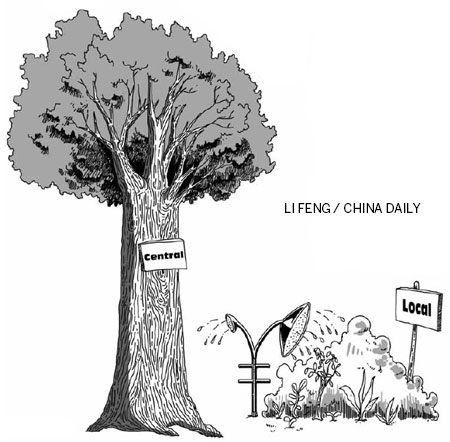
The November plenary session has the historical responsibility of delivering a blueprint of reform to realize the Chinese Dream of establishing a moderately prosperous society by 2020. In this pursuit, China's reform initiatives will be challenged by the global economic slowdown, which could exacerbate the country's domestic imbalances.
The Chinese leadership is thus under greater pressure to implement comprehensive reforms to ensure sustainable growth amid the volatile international environment.
The leadership has already taken some important decisions to deepen the structural transformation of the economy. Chief among them is the recent establishment of a pilot free trade zone in Shanghai.
But more far-reaching reforms, especially in fiscal and financial sectors, are expected to be presented and discussed at the November plenum. A greater role for the market in the economy is also likely to be discussed.
While all areas are central for a prosperous China, I would like to highlight the importance of strengthening fiscal policy to support inclusive growth and improve people's living standards.
These important goals are reflected in the 12th Five-Year Plan (2011-2015), which acknowledges the key role fiscal policy plays in narrowing the income gap and supporting economic restructuring toward a more balanced pattern of growth. We at the Asian Development Bank share the Chinese government's vision to make the country's development more inclusive and balanced for the benefit of the Chinese people.
The challenge of designing an efficient fiscal policy has a long history worldwide. Decades ago, major international studies proved an optimal system should minimize distortion, maximize social welfare and correct negative externalities, especially those harming the environment and public health. This fundamental idea is still alive, and the topics are being actively debated in many countries, including China.
China has undergone significant fiscal reforms that have helped build the solid fiscal position it is in today. The current fiscal system is the result of a series of incremental reforms. From the late 1970s until the crucial fiscal reform of 1994, Chinese policymakers have experimented with different approaches to establish a fiscal model compatible with the country's fundamental ideology and its evolving economic model.
 New type of urbanization is in the details

Copyright 1995 - . All rights reserved. The content (including but not limited to text, photo, multimedia information, etc) published in this site belongs to China Daily Information Co (CDIC). Without written authorization from CDIC, such content shall not be republished or used in any form. Note: Browsers with 1024*768 or higher resolution are suggested for this site.
License for publishing multimedia online 0108263 Registration Number: 130349