|
 |
|
Ancient Villages in Southern Anhui (CNTV)
|
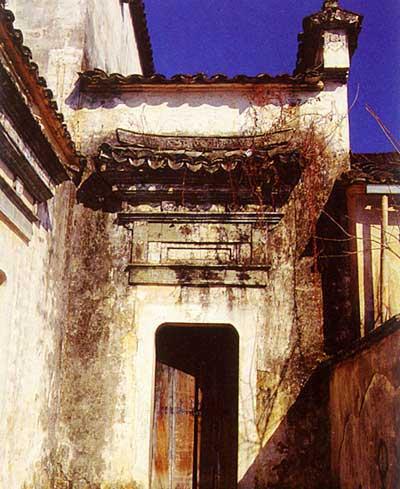
Xidi Village now has 124 well-preserved ancient buildings from the Ming and Qing dynasties and three ancestral halls, including the Lingyun Pavilion, Cishi Pailou, Ruiyu Courtyard, Taoli Garden, East Garden, West Garden, Dafu Residence, Jing'ai Hall, Qingyun Pavilion and Yingfu Hall, all of which can be called models of the Huizhou-style of architecture in the Ming and Qing dynasties and were hailed as 'the residence museum of Ming and Qing dynasties in China'. All of the houses in Xidi Village look splendid and elegant including the delicate gardens, doorframes and perforated windows made of black marble, stone-carved flowers, birds and animals, brick-carved towers and pavilions, as well as refined wood carvings, gorgeous colored drawings and murals, all of which demonstrate the essence of ancient Chinese art. It can be called a rare ancient architectural complex in China with a 'perfect layout, artful structure, beautiful decoration, refined construction and deep cultural connotation' and is a 'pearl' in Huizhou-style residences.
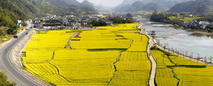
Hongcun Village is 10 kilometers away from northeastern Yixian county and was established in the first year of Shaoxing during the Southern Song Dynasty (1131 A.D.). It covers an area of about 19 hectares and was the region where people with family name of 'Wang'lived. 137 historic buildings constructed during Ming and Qing dynasties (from 1368 A.D. to 1911 A.D.) are well preserved. The historic buildings were constructed with white walls and grey tiles and were orderly arranged. The Chengzhi Hall is the largest and most delicate representative of the ancient buildings, and is considered as the 'exhibition hall of Huizhou wood carving crafts'.
The various wood carvings of the Chengzhi Hall with many structural levels are complex and lively, and are still magnificent after more than 100 years. Hongcun Village is called the 'cattle-shaped village' because it looks like a black cattle lying beside the mountains and streams if people look down from above. The lofty and verdant Lei Mound is the cattle's head, the towering old trees are the cattle's horns, and the houses arranged in picturesque disorder from east to west look like the cattle's huge body. The Yinqing Spring is the 'cattle's rolls', flowing across the half-moon shaped pond which is the 'cattle's stomach', before flowing into the South Lake outside the village which is considered as the 'cattle's tripe', and the four wood bridges on the western stream of the village are considered as the 'cattle's feet'. Such an ingenious design of the village's water system provided convenience for villagers to use production water, living water and fire demand water, and also adjusted the temperature and environment of the village. The cattle shaped village and the manmade water system planned and constructed by the ancient villagers of Hongcun Village is 'one of the great wonders in the history of architecture'.
|