|
 |
|
Ancient Villages in Southern Anhui (CNTV)
|
Date of Inscription: 1999
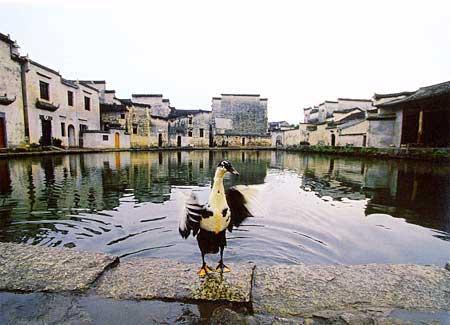
Xidi and Hongcun are two traditional ancient villages that still hold the appearance of villages that had disappeared or changed in the last century. The style of their streets, the ancient buildings and decorations, as well as the residences with a complete water system all are unique cultural heritage.
Chinese Name: Yuan Nan Gu Cun Luo – Xi Di and Hong Cun
English Name: Ancient Villages in Southern Anhui – Xidi and Hongcun
Based on the selection criteria C(III)(IV)(V) for selecting cultural heritage, the ancient villages of Xidi and Hongcun were listed in the World Heritage List in December 1999.
The Ancient Villages in Southern Anhui refer to the mountain regions south of the Yangtze River in Anhui province and to traditional villages with a common regional cultural background and strong cultural features of Huizhou. The mountain regions in southern Anhui have a long history and deep cultural deposits, maintaining a large number of traditional buildings and villages that are similar and distinctive. The Ancient Villages in Southern Anhui were cleverly integrated with the surrounding topography, landforms and landscapes. In addition, as the businessmen in the Ming and Qing dynasties had strongly supported the economic development of their hometowns, the cultural education in those areas was increasingly prosperous. After returning to their hometowns, these businessmen constructed their houses with a mentality of elegance, purity, uniqueness and free from vulgarity, giving the ancient villages a richer cultural environment and prominent village landscapes.
The largest difference between the ancient villages and other villages is that the construction and development of these ancient villages in southern Anhui are independent of agriculture to a large extent. The villagers in these villages have largely surpassed common peasants and citizens in terms of their awareness, lifestyle and taste. They maintained and strived to keep in touch with the literati and officials. Therefore, these ancient villages have a deep cultural atmosphere. Based on the common housing construction, villagers in these ancient villages used different decorative techniques to build small gardens, dig pools, constructed perforated windows, arranged bonsai, carved on beams and hung horizontal inscribed boards, creating an elegant living environment which all reflected the local villagers' high quality and artistic accomplishments. The location selection and housing construction in the ancient villages followed the geomantic theory on the Book of Changes which has more than 2,000 years of history and emphasizes the theory that man is an integral part of nature and respect for the natural environment, focusing on both material and spiritual needs, and has a scientific basis and high aesthetic standards.
|