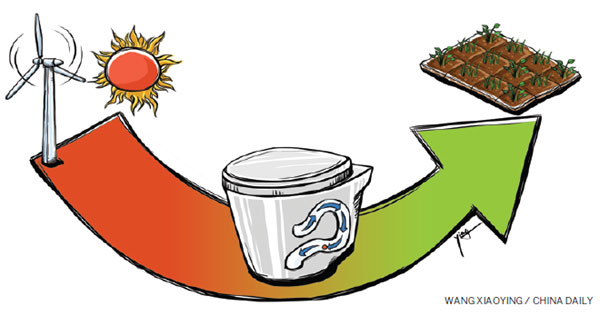
Experts around the world are working hard to provide solutions to environment pollution, especially the increasing damage that human activities are causing in water systems, said Zhang Jian, president of EnviroSystems Engineering and Technology Co, a company in Beijing focused on vacuum-drainage technology, and sewage and waste.
Zhang said human waste contributes more than 90 percent of the nitrogen and phosphorus released into the world's lakes, rivers and oceans. Scientists are now tackling the two elements as the main focus of their work.
Too much nitrogen and phosphorus in the water causes algae to grow faster than ecosystems can handle, damaging the water quality, food resources and habitats, and depleting the oxygen that aquatic life needs to survive. Some algae blooms also produce elevated levels of toxins and bacterial growth that can cause a range of illnesses, some serious, in humans.
"Nitrogen and phosphorus are like two drops of ink. Other human wastewater, such as that used for washing clothes or bathing, are much less harmful and can be described as 'clean' water," Zhang said. "But if we expel the 'two inks' through the underground drainage system into the large pool of 'clean water', it's extremely difficult to remove those two drops."
In 1985, Zhang moved to Germany, where he spent 10 years researching how developed countries treat the burden human waste imposes on the environment. "I finally realized that the situation in China is absolutely different," he said.
Western Europe and North America have had mature underground drainage systems for centuries, and many countries in those regions are facing negative population growth, thus relieving the burden on their sanitary systems. "To achieve source separation (preventing liquid and solid waste from mixing in the sewage system) would cost too much money and effort. So those areas focus on garbage recycling rather than the toilet revolution," Zhang said.
In 2003, he started work on an eco-toilet that could achieve source separation. His design is as similar to Fan's, but is supported by a solar-powered vacuum assist.
Fan's next plan is to install a type of vacuum trash can in the houses in Chentang and link them to the existing system. The design will mainly be used to collect kitchen waste, which can be mixed with human waste to ferment and be used as fertilizer.
"If kitchen waste is removed from domestic solid waste, the cost of waste treatment in the rural areas would be cut by about 80 percent," he said. "The biggest challenge we face is not related to technology, but whether the government values the potential benefits and supports and promotes the idea."


Copyright 1995 - . All rights reserved. The content (including but not limited to text, photo, multimedia information, etc) published in this site belongs to China Daily Information Co (CDIC). Without written authorization from CDIC, such content shall not be republished or used in any form. Note: Browsers with 1024*768 or higher resolution are suggested for this site.
License for publishing multimedia online 0108263 Registration Number: 130349