|
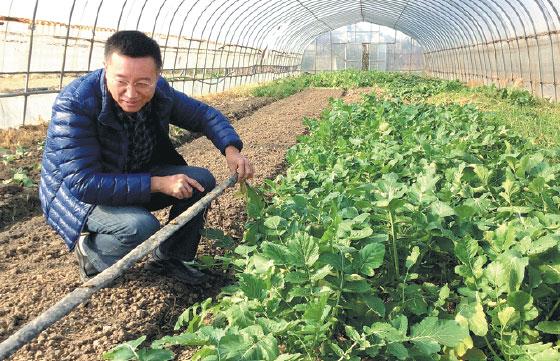
Fan checks a drip-irrigation pipe in a greenhouse in Chentang on Dec 3. Liquid human waste from vacuum-assisted toilets is stored underground before being sprayed directly onto farmland as fertilizer. |
All that ended in spring 2011, when Wang bought the vacuum toilet. Essentially, the appliance is hooked up to a vacuum sewer system, and when the flush button is pushed, a valve opens and the contents of the toilet bowl are sucked into a special storage container.
"There is no bad smell at all," Wang said. As a farmer, he is extremely satisfied with the toilet's ability to collect human waste, which can be used as fertilizer on his fields.
"Rice seedlings nourished by the human fertilizer grew higher than those grown with chemical fertilizer, and the rice tasted sweeter," he said. He added that he had sent the rice to the provincial agriculture products testing center, where the lack of chemicals used in cultivation resulted in it being classified as organic produce.
Avoiding health risks
Vacuum toilets have been used by commercial airlines for years, but now they are being used in large-scale residential sanitation in China for the first time. "Unlike normal flush toilets which work via gravity, the vacuum toilet has pipelines that can be designed according to the structure of the building. That makes installation easy, even in the old residential areas," said Fan Bin from the Research Center for Eco-Environmental Sciences at the Chinese Academy of Sciences.
Fan initiated the sanitation project in Chentang. Having been born and raised in a similar village, he has a deep conviction that it's time for a sanitation revolution in rural China.
Dry toilets, both the public and private varieties, are still abundant in the villages of rural China - large, open pits covered by a rudimentary shelter, with a narrow cement or wooden platform for standing or squatting.
In this traditional sanitation system, no water is needed and the waste can be taken out every day for use as fertilizer. The system is eco-friendly, but inconvenient and dangerous - as evidenced by countless stories of children or seniors who have slipped and accidentally fallen into the hole. Moreover, the pits pose a health problem because of the smell and the potential to spread disease.In 2011, the world's biggest private foundation - The Bill & Melinda Gates Foundation - launched the "Reinvent the Toilet Challenge" to encourage a global search for innovations that would prompt next-generation sanitation. "It inspired me to promote a pilot project in rural areas, so I began designing a system with a vacuum toilet that would be suitable for China's rural areas," Fan said.
Using Fan's design, 41 vacuum toilets were installed in 23 houses in the Hehuageng district of Chentang. The toilets are connected to an electric-powered vacuum-assist system that conveys the waste to an underground storage tank where it is separated for use as solid and liquid fertilizers. Tubes connected to the tank spray the liquid fertilizer directly onto farmland about once a month, while the solid waste is emptied once or twice a year and is also used as fertilizer. A technician visits regularly to check performance and safety features, but only a couple of small problems have been reported in the past four years.
The entire system costs about 20,000 yuan per family, but according to Fan, if it could be produced on a larger scale, the vacuum toilet could be far cheaper than the flushing models, not to mention the environmental benefits. "That's why I'm calling for widespread use of this technology in rural areas to keep the cost low," he said.
The system works well, according to Fei Xiaoliu, 56, who has installed a vacuum toilet in her house. "Many people from other residential areas came to visit our new toilet. Almost every person asked how they could get one. It's not troublesome at all because it doesn't emit bad smells," she said.


Copyright 1995 - . All rights reserved. The content (including but not limited to text, photo, multimedia information, etc) published in this site belongs to China Daily Information Co (CDIC). Without written authorization from CDIC, such content shall not be republished or used in any form. Note: Browsers with 1024*768 or higher resolution are suggested for this site.
License for publishing multimedia online 0108263 Registration Number: 130349