The nation's legal eagles are assessing a series of far-reaching reforms to the legal system designed to improve the service and allow judges greater independence when hearing cases and reaching verdicts, as Cao Yin reports.
 |
|
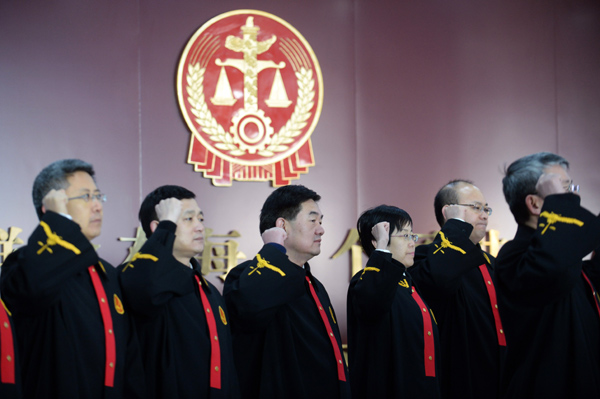
Judges from the Second Circuit Court of China's Supreme People's Court taking the oath when the court was established on Jan 31 in Shenyang, the capital of Liaoning province. The new circuit courts are part of a series of reforms designed to better deal with the workloads of courts across the country. [MU YING/CHINA DAILY] |
Four days before the Beijing Intellectual Property Court opened on Nov 6, Jiang Ying was invited to join the new institution as a senior judge.
Although the 47-year-old was happy in her old job, she couldn't resist the opportunity to work at the IP court, which is part of a pilot program to assess the impact of a series of reforms to the judicial system proposed by the central leadership in Oct 2013.
During her 20 years as a judge at the Beijing No 1 Intermediate People's Court, Jiang had heard and ruled on many IP disputes, but she was still nervous and excited when she arrived at her new workplace.
"The IP court is a pilot program to develop new ways of hearing IP-related cases and to explore other areas that may benefit from reform," she said.
The court is testing proposed new national guidelines that will affect the way judges are allocated, and that will allow them to reach verdicts without the need to review every case with senior colleagues, according to Jiang.
The reforms propose that the nation's judicial officers should be split into three groups: Approximately 30 percent will become judges and prosecutors, 50 percent will be classified as legal assistants, and the rest will oversee administration.
"In other words, it will be harder to become a judge, and we expect to see an obvious decline in their numbers to publicly indicate that the system is being streamlined to improve efficiency," she said.
The IP court currently employs 25 judges, including three court presidents. A number of younger judges will become assistants when the reform is rolled out nationwide, although the timetable has yet to be finalized.
According to Jiang, some judges in other courts have complained about the allocation system, fearing that their roles will change and they will be prevented from hearing cases.
"Very few of my colleagues in the IP court agree with the critics. Some younger judges, such as those who have worked for less than five years, are quite keen to become legal assistants because they realize they still have a great deal to learn," she said.
The reduction in the number of judges will promote greater professionalism among those hoping to make it to the top tier, and will also improve their ability to form judgments if they do make the grade, she added.
"Moreover, the judges who work here are experts in IP disputes, and they're afraid they won't be allowed to hear them if they are moved elsewhere or their roles are changed, because the reform stipulates that IP cases will only be tackled in the IP court," she added.
Related Stories
Copyright 1995 - 2015 . All rights reserved. The content (including but not limited to text, photo, multimedia information, etc) published in this site belongs to China Daily Information Co (CDIC). Without written authorization from CDIC, such content shall not be republished or used in any form. Note: Browsers with 1024*768 or higher resolution are suggested for this site.
License for publishing multimedia online 0108263 Registration Number: 130349