The NPC votes to update the cornerstone of China's legal system to dispel confusion and prepare the way for more changes, as Zhang Yi reports.
 |
|
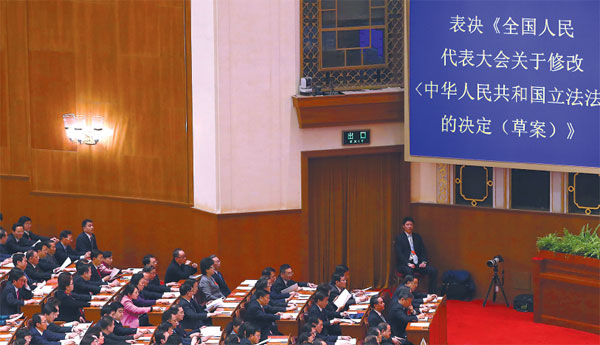
The amendment to the Legislation Law, the cornerstone of China's legal system, is ratified at the closing session of this year's National People's Congress on Sunday. As part of a process of ongoing legal reform, the amendment is intended to remove ambiguous language and legal definitions, streamline the lawmaking process, and further tighten the administration of the law. Pang Xinglei / Xinhua |
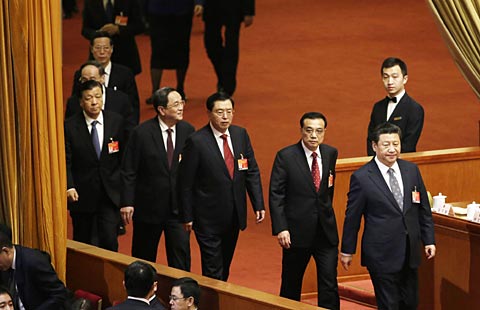
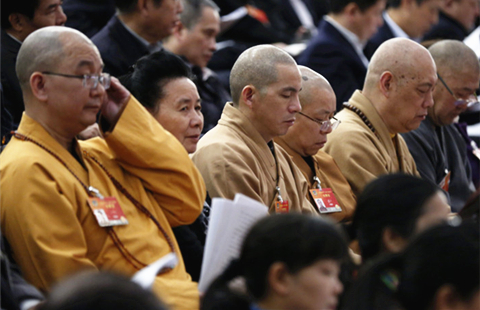
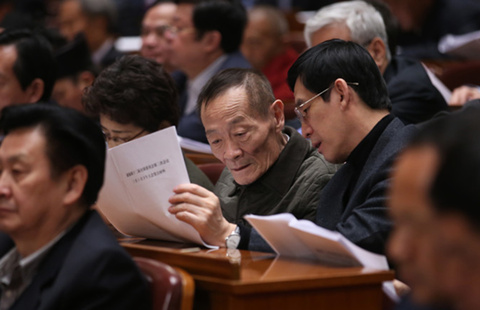
The amendment, ratified at the closing session of this year's National People's Congress on Sunday, is part of a process of ongoing legal reform. About 3,000 deputies voted, with 2,761 in favor of the amendment, while 81 voted against and 33 abstained. The number of "yes" votes easily outnumbered the dissenters, thus fulfilling the constitutional requirements for passing the amendment.
Since coming into effect in July 2000, the Legislation Law has served as the cornerstone of China's legal system. It regulates how national and local laws are made, and stipulates responsibility for their administration. The amendment, proposed at the beginning of last year, is intended to remove ambiguous language and legal definitions, streamline the lawmaking process, and further tighten the administration of the law.
"The revisions are expected to improve the legal system, raise the quality and efficiency of legislation, maintain the unity of the legal system and the nation, establish a sound system of laws, modernize China's governance system and the capacity for governance, and build the country under the socialist rule of law," said Li Jianguo, vice-chairman of the Standing Committee of the National People's Congress, when he explained the changes at the plenary session last week.
Gu Shengzu, a member of the NPC's Financial and Economic Affairs Committee, said only good laws can promote good governance, and that the Legislation Law was specifically formulated to produce "good laws". He said the amendment underscores the fact that people's congresses at all levels are authorized to enact legislation, and it also removes any confusion between the law and government policies, which are often regarded as one and the same.
Ma Huaide, vice-president of the China University of Political Science and Law in Beijing, said the amendment stipulates exactly which bodies are allowed to enact legislation, which is a major achievement and a giant stride toward strengthening the rule of law.
According to Ma, 75 percent of the draft laws initiated at NPC meetings in the past 10 years were written by government departments, rather than people's congresses, but Sunday's amendment clearly identifies the congresses as the only bodies authorized to make laws.
"When government departments hold legislative power, the lawmaking process can easily be manipulated in favor of departmental interests. These departments are always likely to opt for the provisions that benefit them the most, and are less concerned about public demand or necessity," Ma said, adding that in the past lawmakers didn't have a completely free hand to enact legislation because the process was often controlled by the central government and different administrative departments.
The amended law identifies the NPC as the only body authorized to draft national laws and emphasizes that the congress is in overall control of the legislative process. It also clarifies how national and local laws come into shape and carefully identifies the legislative power of each government department.
The move has also raised the number of cities that the NPC has entrusted with legislative powers to 282 from the current 49, but has limited their scope to local laws related to "rural and urban development and management, environmental protection, and the preservation of historical heritage and cultural values".
Related Stories
Copyright 1995 - 2015 . All rights reserved. The content (including but not limited to text, photo, multimedia information, etc) published in this site belongs to China Daily Information Co (CDIC). Without written authorization from CDIC, such content shall not be republished or used in any form. Note: Browsers with 1024*768 or higher resolution are suggested for this site.
License for publishing multimedia online 0108263 Registration Number: 130349