 |
|
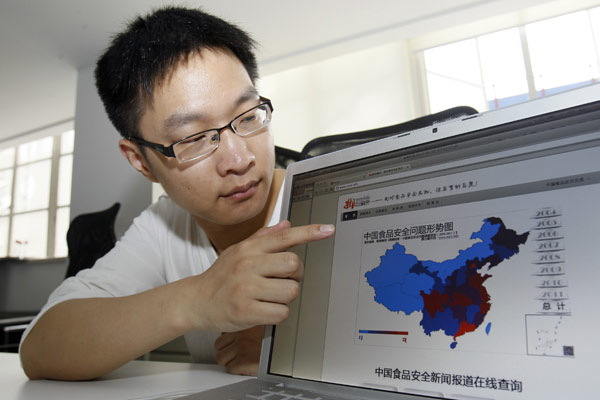
Wu Heng, a graduate student at Fudan University, shows a website on food safety. YONG KAI /FOR CHINA DAILY
|
His reaction to Upton Sinclair's book The Jungle, an expose of conditions in the industry at the turn of the last century, also apparently contributed to the passage of the Pure Food and Drug Act.
Now Chinese webmaster Wu Heng is hoping to draw the same attention to food safety issues here.
The site he set up with 33 other volunteers, Zhi Chu Chuang Wai (www.zccw.info), which means "throw out of the window", attracted so many visitors on May 3 that it crashed due to traffic overload.
"Over the past week, the website attracted about 2 million visits. We had to change the server overnight to cope with it," said Wu, 26, a third-year graduate student majoring in history at Fudan University in Shanghai.
"Roosevelt's act of throwing his sausage out of the window became a watershed in the history of food safety. I hope my website can play a role as well in raising the alarm in our country's food safety," said Wu.
It took Wu and other volunteers one month to research and set up the database for the website, which went online last June.
During the research process, volunteers read more than 17,000 news articles and made more than 2,400 entries into the database, tracking media reports of food safety issues since 2004.
It received an average of 10,000 visitors a day just 10 days after its launch.
"I had thought tainted food was an issue far removed from my own life, but it's not," he said, recalling his reading of a news report on a food safety scandal about beef. As it happens, rice with braised beef is Wu's favorite dish.
"After reading that, I was shocked and angry," Wu continued. "Then I decided to establish the website."
On the site, users can find the latest news reports about food safety issues across the country by location or food types.
In addition, users can input keywords like "gutter oil" and "sulphur dioxide" to look for related articles.
The site also displays a map of China with regions highlighted in different colors to indicate levels of food safety between 2004 and 2011, which shows that reported incidents of food safety problems have grown over time.
"This also has to do with increasing media awareness on food safety," Wu explained.
"The fact that east coast areas appear more serious than other areas also has to do with the difference in media attention."
The website allows netizens to contribute food-safety-related information and leave messages or propose questions.
Wu has also set up a weibo account, through which netizens can forward new findings.
"This is a story possible only in the Internet era," Wu said.
Among the other 33 volunteers, Wu said he only met five of them face to face. The rest joined the team through the Internet, most of them college students.
"I signed up to be a volunteer the moment I learned of the project," said Wang Chenying, a volunteer with the website.
"While collecting data for the website, I found a sense of achievement serving the public, which I can't find from doing any other things."
The website has also received a nod from officials.
"Food safety issues are among the public's top concerns. It's good to see that students have provided such a service for the public," Gu Zhenhua, deputy director of the Shanghai's food safety agency, told China Daily.
"We in the government also run similar websites providing not only media reports but also government reaction and related laws and regulations, only we focus more on local regions," Gu added.
With graduation one month away, Wu - who is working as an intern at an Internet company - said he will continue to work with the website in his spare time.
"This is just an information sharing platform. For more scientific explanations, one should turn to professionals," Wu said, adding that he and his team are also planning to invite some experts to join their website for professional guidance.
"At least the website offers a platform for people to decide what not to eat," he said.
wanghongyi@chinadaily.com.cn


Copyright 1995 - . All rights reserved. The content (including but not limited to text, photo, multimedia information, etc) published in this site belongs to China Daily Information Co (CDIC). Without written authorization from CDIC, such content shall not be republished or used in any form. Note: Browsers with 1024*768 or higher resolution are suggested for this site.
License for publishing multimedia online 0108263 Registration Number: 130349