Oil giants see no threat from electric car
Updated: 2012-02-06 13:29
(chinadaily.com.cn/Agenceis)
|
|||||||||||


Greens fume, politicians see quicker adoption
Green groups reacted with suspicion to the oil industry forecasts.
"Exxon would say that, wouldn't they. A big take-up of electric cars is not something they would like to see," said Jos Dings, director of Brussels-based sustainable transport campaign group, Transport and Environment.
"The future for petrol and diesel doesn't look good," he countered.
Nonetheless, environmentalists like Dings fear political complacency about improving vehicle efficiency could prompt governments to ease targets to cut vehicle emissions, which could in turn delay the electrification of transport.
Big Oil's pessimistic outlook for electric cars is at odds with many governments' plans.
Electric vehicles barely register on the statistics of car sales at the moment. Nonetheless, China is targeting 5 million electric vehicles on its roads by 2020, according to media reports. This would represent around 3 percent of its predicted fleet.
The Australian government's main energy adviser, the Australian Energy Market Commission, has predicted electric vehicles will make up 20 percent of new car sales in Australia by 2020 and 45 percent by 2030.
The UK's Committee on Climate, which advises the government, has predicted electric vehicles will reach around 60 percent of new cars and vans by 2030. And New Zealand hopes to get to 60 percent by 2040.
The US has more muted ambitions. President Barack Obama said he wants to put 1 million electric vehicles on US roads by 2015, a figure that would represent less than half of one percent of the total fleet.
Many US experts and officials predict a tipping point in the uptake in electric vehicles in the latter part of this decade, as technology improves, economies of scale kick in and consumer fears about being stranded when their batteries run flat, or "range anxiety," eases.
However, data compiled by the US Energy Information Administration may explain the lack of an official US target. Last week, the agency released an 'abridged version' of its Annual Energy Outlook 2012, due to be released in full in the Spring.
Tables used in formulating the outlook show electric vehicles and plug in hybrids are expected to account for only 1.3 percent of the US fleet in 2030.
Furthermore, the agency predicts that neither consumers, nor carmakers, will get over 'range anxiety'. By 2035, the agency sees few, if any, electric vehicles on US roads that can travel for 200 miles without recharging.
Carmaker enthusiasm cools
|
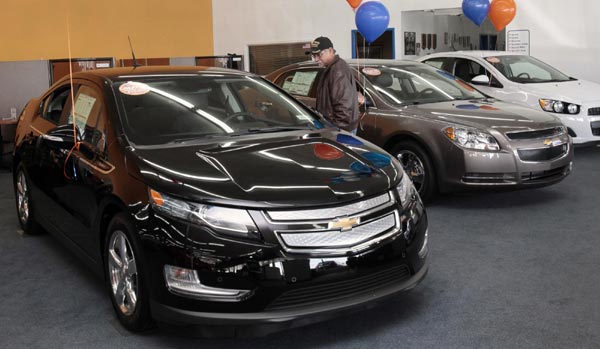 A potential customer looks at a black 2012 Chevrolet Volt electric vehicle in the showroom of George Matick Chevrolet auto sales in Redford, Michigan, Jan 31, 2012. [Agencies] |
Many of the headlines out of autoshows in the past couple of years have been captured by the launch of electric cars such as Nissan's Leaf, the Tesla sports car, plug-ins like General Motors' Chevrolet Volt, and the latest incarnation of the Toyota Prius.
Other manufacturers including BMW, Rolls-Royce and Porsche have presented electric-powered prototypes.
On the basis of this, one could be forgiven for thinking the auto industry is betting big on electric power.
Yet few auto executives share the optimism of Renault and Nissan chief executive Carlos Ghosn who has repeatedly said he sees electric vehicles making up 10 percent of all sales in 2020.
|
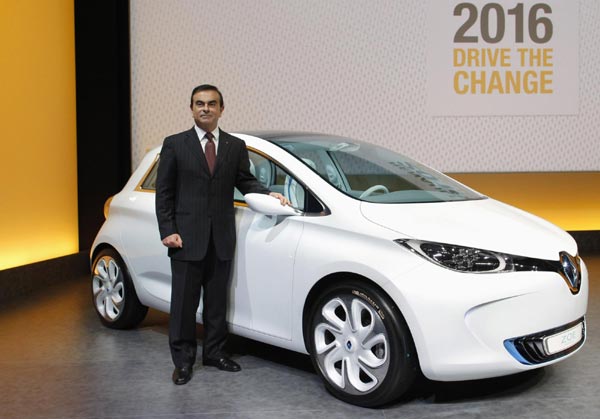 Carlos Ghosn, chairman and chief executive officer of French carmaker Renault, poses next to a Renault Zoe preview electric car after a news conference to present the company's 2010 annual results and their business plan "Drive the change" in Boulogne-Billancourt near Paris in this Feb 10, 2011 file photo. [Agencies] |
A survey of 200 auto industry executives conducted by KPMG released earlier this month gave an average forecast for electric vehicles to account for 6-10 percent of global auto sales in 2025 - more bullish than Exxon and BP but hardly a revolution.
"Certainly a year ago or so, you could have gotten the impression from reading the press that everyone is driving electric cars in two years time," Daimler CEO Dieter Zetsche said at a roundtable at the sidelines of the Detroit auto show last month.
Zetsche said he did not see "an explosion of demand for this product."
Echoing comments from the oil companies, Gerd Kleinert, CEO of KSPG, the automotive parts business belonging to German group Rheinmetall, says take-up of electric cars will be curtailed until batteries can store energy using as little weight as gasoline does, and can be recharged as quickly as refilling a fuel tank.
"When that world exists, then we will all be driving electric cars starting tomorrow. But I personally don't see that happening, not even a hundred years from now."
- CNPC operates 16m cubic metre fuel storage
- City to relocate smelting plants after toxic spill
- Central Huijin plans for banks to cut dividend ratios
- China bans airlines into EU carbon scheme
- Work safety highlighted before leadership transition
- Water diversion project to be operational in '13
- Vanke Jan home sales tumble 40%
- SAIC revives Shanghai brand