Oil giants see no threat from electric car
Updated: 2012-02-06 13:29
(chinadaily.com.cn/Agenceis)
|
|||||||||||


|
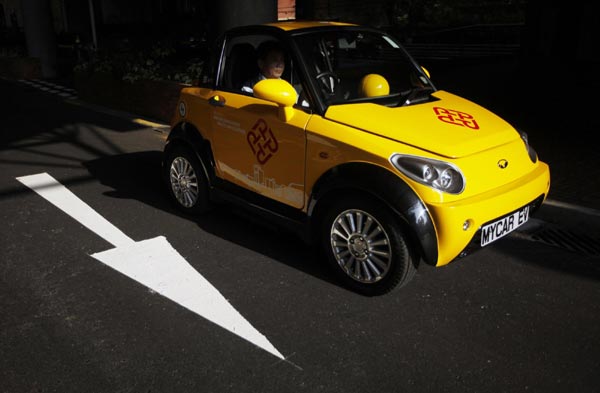 A driver drives the latest version of "MyCar", an electric car made by the Hong Kong Polytechnic University, inside the university campus in Hong Kong Jan 30, 2012. [Agencies] |
The biggest oil companies in the world have calculated that few, if any, of today's drivers will see electric cars outnumber gasoline and diesel models in their lifetimes.
While politicians and green lobby groups insist the future of transport is electric, in the past two months BP and Exxon have released data which points to electric cars making up only 4-5 percent of all cars globally in 20-30 years.
Meanwhile some governments are targeting as much as a 60 percent market share for electric vehicles over a similar period.
The oil company forecasts may appear self-serving, but if they are widely accepted could provoke a policy shift that offers greater incentives for electric cars to end our addiction to oil.
And unlike more optimistic predictions from consultants like McKinsey, these forecast are backed by cash. They guide tens of billions of dollars in long-term investment in oil production and refining and it is oil that stands to lose if they get it wrong.
They don't, of course, take into account a major breakthrough in battery technology that could give electric cars a cost and performance edge over the internal combustion engine.
In its Energy Outlook for 2030, released earlier this month, BP predicted that electric vehicles and plug-in hybrids, will make up only 4 percent of the global fleet of 1.6 billion commercial and passenger vehicles in 2030.
"Oil will remain the dominant transport fuel and we expect 87 percent of transport fuel in 2030 will still be petroleum based," BP Chief Executive Bob Dudley said as he unveiled the BP statistics on Jan 18.
The balance is seen coming from biofuels, natural gas and electricity.
Plug-in hybrids can be powered from the mains and only rely on their small gasoline engines when the battery dies.
Standard hybrids are principally driven by an internal combustion engine whose efficiency is boosted by the recycling of energy generated from braking.
Exxon Mobil, the biggest oil and gas company in the world, says the continued high cost of electric vehicles compared to petroleum cars, means take-up won't even increase much during the 2030s.
In its 2040 Energy Outlook, released in December, the Texas-based company said electric vehicles, plug-in hybrids and vehicles that run on natural gas would make up only 5 percent of the fleet by 2040.
Peter Voser, Chief Executive of Royal Dutch Shell, the industry number two, sees a rosier future for electric vehicles. He predicts they will account for up to 40 percent of the worldwide car fleet, although only by 2050.
A $50b-a-year opinion
The statistics published by Exxon and BP, Europe's second-largest oil company by market value, are perhaps the most detailed long-term forecasts on electric vehicle take-up.
These Energy Outlooks guide how the oil groups allocate their annual investment budgets - among the biggest in the world, at over $50 billion combined for BP and Exxon.
The expected continued dominance of petroleum partly explains the scaling back in BP and Shell's solar, hydrogen and wind power ambitions in recent years, and Exxon's continued reluctance to get involved in renewable energy.
Insofar as the companies are active in green energy, it is mainly in the production and blending of biofuels. This is driven by US and European governments' insistence that a percentage of motor fuels sold must come from plant-based sources.
If the oil companies are wrong about electric cars they will find their investments in big and expensive new oil production projects, which increasingly need crude prices around $80 per barrel to be profitable, not paying off.
The companies do see an easing in the addiction to oil, though.
Despite increased car ownership in China and India, Exxon predicts "global demand for fuel for personal vehicles will soon peak" due to an increase in average fuel efficiency.
BP expects the efficiency of combustion engines to double by 2030, with a third of vehicles on the road being hybrids.
This trend will be driven by more stringent fuel economy standards in the US, CO2 reduction legislation in Europe and an end to oil subsidies in developing countries.
Increased airline and commercial vehicle traffic will counterbalance some of the efficiency gains from cars but BP predicts that, helped by increased use of biofuels, demand for oil for transport overall will plateau in the mid-2020s.
- CNPC operates 16m cubic metre fuel storage
- City to relocate smelting plants after toxic spill
- Central Huijin plans for banks to cut dividend ratios
- China bans airlines into EU carbon scheme
- Work safety highlighted before leadership transition
- Water diversion project to be operational in '13
- Vanke Jan home sales tumble 40%
- SAIC revives Shanghai brand