


Digging up the past to help the future










Archaeologists endure backbreaking work and long hours but every now and then they find something to make their efforts worthwhile, Wang Ru and Sun Ruisheng report in Taiyuan.
Li Lei remembers his first experience with an archaeological exploration in 2007, when he was still an undergraduate working as an intern for a project in Zhangjiakou, Hebei province. After being shown soil coring skills, inserting a Luoyang shovel (curved spade) into the ground and then extracting it to see the layers, he tried to copy it by using the shovel to dig up earth. The hole he excavated was much wider than normal, which caused people standing nearby to laugh.
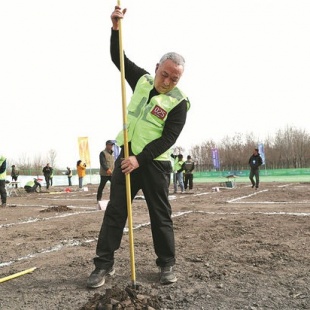
After years of working in field archaeology, Li, 38, who now works at Hebei Provincial Institute of Cultural Relics and Archaeology, could confidently display his full range of skills at the National Vocational Skills Competition on Cultural Relics held in Taiyuan, Shanxi province, in March.
Organized by the National Cultural Heritage Administration, Ministry of Human Resources and Social Security and All-China Federation of Trade Unions, the event held competitions on archaeological exploration skills, restoring wooden cultural relics, tiles and brickwork, porcelain and pottery, murals and bronze ware.
"Restoring cultural relics is about craftsmanship. But I guess nobody has a deeper understanding of the newly unearthed artifacts than us, who are engaged with field archaeology," says Li.
The competition on archaeological exploration skills measures a competitor's coring skill, which is part of the archaeological survey usually conducted before excavations to provide reference for further digging.
According to Hai Jinle, former deputy director of the Shanxi Provincial Institute of Cultural Relics and Archaeology, who worked as a judge for the competition, archaeological survey usually involves studying the terrain to observe the condition of the land and then select areas for coring.
From the stratigraphic perspective, strata are deposited in a chronological order, with the oldest layer at the bottom. Human activity impacts layers, making them very different from each other in color and texture of the soil and its inclusion. As a result, by coring, people can discover archaeologically interesting layers and identify their time, says Hai.