


Digging up the past to help the future










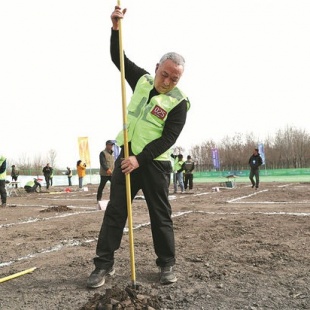
He has taken part in a number of important discoveries, like the Gaohong site in Liulin county, Shanxi, Hengshui Western Zhou Dynasty (c. 11th century-771 BC) grave complex in Yuncheng, Shanxi, and the Shizitan Paleolithic site in Jixian county, Shanxi. All were on the list of China's top 10 new archaeological discoveries, an annual compilation often referred to as the "Oscars of Chinese archaeology".
Niu won second prize in the competition. He has received a reemployment request after retirement from where he works, and is ready to continue his work for another five years.
Recalling his past years, Niu says, "The work is good for me. There are so many impressive moments in doing archaeological work. It seems I blinked my eyes and in an instant, decades had passed."
Li grew an interest in archaeology as a middle school student, and this led him to work as a volunteer and an intern in the archaeological field when he was a computer major at the University of Electronic Science and Technology of China in Chengdu, Sichuan province. In 2013, he was recruited by the Hebei Provincial Institute of Cultural Relics and Archaeology, and officially began his archaeological career.
His interest has been kept since he is able to decode the past through his work. "For example, when we excavate a tomb, we can know their burial rituals, customs of their lives and even their races and how they migrated in the ancient time. Historical records reveal some things, although they are not always accurate," says Li.
He has applied computer technology, like three-dimensional modeling, to field archaeology, which can make it more precise." By borrowing methods from many other subjects, archaeology is increasingly multidisciplinary and precise, but field archaeology is the basis of that," says Li.
Now, he spends more than 300 days a year on average working outdoors with his colleagues. They rarely rest, even on weekends. Work is only disrupted by inclement weather.
"Archaeology is laborious. All of the well-known archaeologists in China, like Xia Nai, Su Bingqi, and Zou Heng, spent a great deal of time in the field. They worked like farmers in the fields, but the result of their research is outstanding in the world," says Hai.