


Digging up the past to help the future










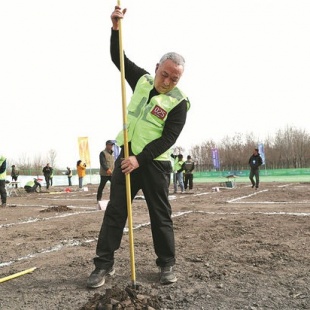
The work is done by swinging a Luoyang shovel, a semicylindrical ironware with an extended rod, as a traditional tool used for archaeological work in China, to dig into the ground and lift the soil sample out. By observing it, one can judge the time of each layer, and form a picture of what occurred in the given place over a period of time. Usually they dig the hole until they reach the natural layer with no evidence of human impact on the environment.
After the procedures, archaeologists can gain a basic understanding of the size, depth, range and type of a site, and have statistics for possible later excavation, according to Li.
The work must be done carefully, or it may disrupt follow-up work. According to Zhang Wentao, who has worked on archaeological exploration for a company in Yinchuan, Ningxia Hui autonomous region, for 13 years, if the initial data of a site is wrongly recorded, it can increase the excavation workload. There are a number of techniques required in the process. For example, archaeologists need to consider how to gain enough information by punching as few test holes as possible.
"Coring causes unavoidable harm to the underground remains. That's why we try to gain information of the underground remains with as few holes as possible," says Li. "Moreover, for different types of sites, the ways of distributing holes are different."
Another difficult point lies in observing the soil to judge the time of layers, since it varies in different places.
"China's archaeological excavation skills have been mainly learned from Western countries, but the coring skill with a Luoyang shovel is our own. It is full of Chinese characteristics," says Qiao Liang, a researcher at China Academy of Cultural Heritage, who worked as chief of judges for the competition.