



Expert advises differentiated treatments for COVID-19









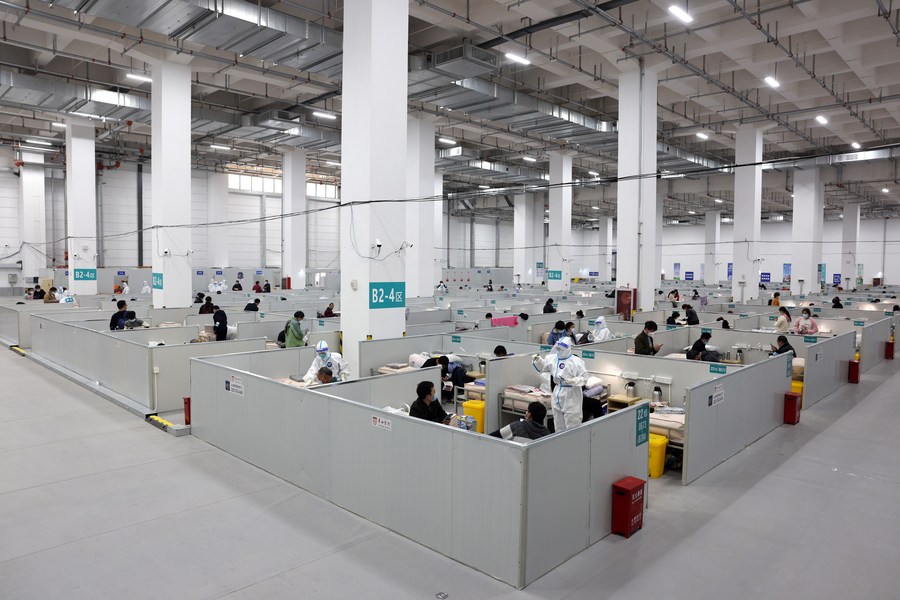
Though generally causing milder symptoms, the Omicron variant can lead to severe cases and even death in those with underlying conditions. A medical expert has advised optimizing the use of medical resources at designated hospitals and differentiated treatments for the infected.
Shanghai reported three new deaths from COVID-19 on Sunday and the primary cause of their deaths was severe underlying illnesses, the municipal health commission said at a news conference on Monday.
A differentiated approach should be taken in treating asymptomatic COVID-19 carriers, patients with mild symptoms, infected people with underlying illnesses, infected people with serious underlying illnesses and severely ill patients, said Ning Guang, an academician with the Chinese Academy of Engineering and president of Shanghai Ruijin Hospital.
Designated hospitals should discharge recovered patients timely and can transfer infected people without underlying conditions to makeshift hospitals to optimize the use of medical resources and concentrate on treating more severe cases, Ning said.
They should also make full use of their high-quality medical resources, he added. He advised designated hospitals set up specialized wards in departments such as nephrology, pneumology and cardiology whose patients with underlying illnesses are more likely to become infected, to further enhance capacity of receiving and treating patients.
Ning said he expected more patients would have to be admitted to the intensive care unit, creating a need to increase the number of beds in ICUs in designated hospitals and moderately open ICUs in non-designated hospitals for use. A screening system for severely ill patients should be set up to monitor those more at risk. Once a patient becomes severely ill, he or she can be immediately admitted to ICU for professional evaluation, diagnosis and treatment.
Isolation wards and makeshift hospitals should enhance their treatment capacity, Ning said. He suggested medical experts make the rounds and hold consultations for difficult and complex cases in isolation wards. Psychologists, clinical pharmacists and traditional Chinese medicine practitioners should be available at isolation wards and makeshift hospitals.
He also stressed medicinal institutions should be cautious against hospital infection while attending to the public's needs for necessary treatment and hospitalization. They must follow strict divisional management, with outpatient, emergency and inpatient departments separated and operating independently, he said.


- Former Bank of Communications vice-president expelled from CPC
- Guizhou village greets Start of Summer with misty dawn
- China launches new round of central environmental inspections
- Chinese technologies and materials help marathon runners create world records
- Moderate soy intake may lower cancer risk
- Macao, Zhuhai launch smart immigration clearance at Hengqin port lanes





