Yet the people themselves, or at least their images, have survived the torrents of history and surfaced in relatively large numbers from the resting places of their Chinese contemporaries, those to whom they had tried to sell everything.
"The images, often rendered as ceramic or clay figurines, speak for the depth with which the Sogdians once penetrated Chinese society, not merely as traders," Rong says. "The influence they exerted, through commerce as well as their mere presence, reached its peak during the Tang Dynasty."
In most of the Tang-era figurines, the Sogdian merchants were portrayed as having a high nose, deepset eyes and thick beard. Equally distinctive was what they wore: turban or pointed hat, lapelled coat or kaftan with narrow sleeves and tightfitting trousers, complete with felt boots.
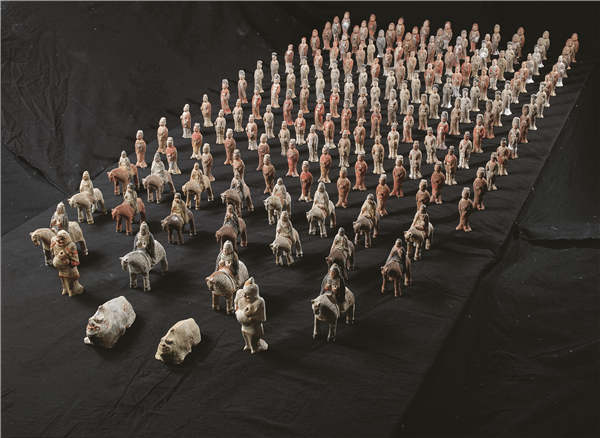
Often they appear alongside or mounting their companion of the road, a camel or a horse. At other times they seem to be enduring the hardship alone: a Tang Dynasty porcelain figurine unearthed in Luoyang city in Henan province depicts a Sogdian merchant holding a water bottle in one hand and carrying a big sack of goods on his bending back. In Luoyang, one of the two major trading hubs of the Tang Empire, large market-based Sogdian communities formed. The other was Xi'an of Shaanxi province, the empire's capital.
The things they sold into the Chinese heartland, often in exchange for the famous silk, touched almost all aspects of local life. Apart from gems and spices, this included metal wares, medicines and even gold and silver coins from various countries along the road.
If all these things contribute to the magic bag of exoticism, for the local Chinese the Sogdians embodied this word. That might explain why as the people of Tang avidly took up everything brought to them through the Silk Road, they also opened their arms to the indigenous culture of the traders, whom they conveniently called the "Hu people". Hu refers loosely to a foreigner and more specifically to Western and Central Asian men who spoke eastern Iranian languages, Rong says.