
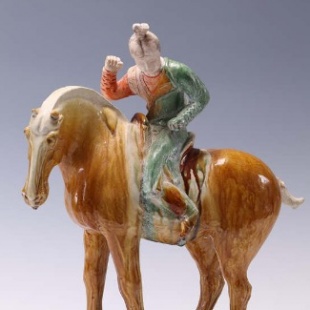



Caught in an unending twirl










"People have been tempted to attribute this apparent lack of loyalty to an unreliability and untrustworthiness associated with merchants. This is unfair; very often the Sogdians had little choice."
Sometimes they were even stalked by political uncertainty while on the road, Rong says, pointing to a wooden-slip document unearthed in Gansu, northwestern China, dated to 39BC. The documents record the disputes between officials at a Silk Road relay station in Gansu and a trade envoy coming from Samarkand.
"The argument seems to have centered on the color and number of the camels being brought by these men. But the back story to this is that before the Sogdians' departure, Samarkand, called the Kingdom of Kang by their Chinese counterparts, was in a friendly relationship with the Han Empire. Yet the situation took a U-turn while these men were heading toward their destination: having provided assistance to Xiongnu troops, Samarkand, by the time of their arrival, had in effect become an enemy country.
"These men should have been grateful that instead of being thrown into prison they only faced a minor dispute."
It is worth noting that in most cases the submissive relationship formed between a Sogdian kingdom and a mightier power usually had nothing to do with military occupation. Rather, the Sogdians were required to pay taxes to their masters, the result of wealth accumulated through trading on the Silk Road.

To amass wealth it was necessary to deal in commodities that could fetch the highest profit, profit huge enough to cover the immense time and human cost demanded by such long-distance trade.
A renowned Chinese historian, Ge Chenyong, says the Sogdians "had an eye for gems".
"Bearing in mind that it could take a year to travel from what is today Iran to China, goods that were light in weight, high in value and easy to carry were the most popular, and gems topped that list," Ge says. "The Sogdian merchants were believed to have sewn those precious stones into a little pouch they tied to the upper end of the thigh or carried under armpit."




















