|
 |
|
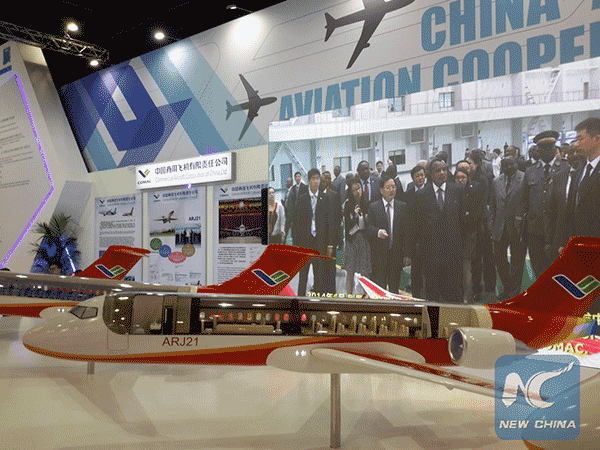
Models of regional jets ARJ21 manufactured by the Commercial Aircraft Corporation of China (COMAC) are seen on display at China-Africa Equipment Manufacturing Industry Exhibition in Johannesburg, South Africa, on Dec. 5, 2015.[Photo/Xinhua] |
JOHANNESBURG -?Chinese and South African technology companies are looking for growth opportunities as China and Africa decide to boost all-round ties by unveiling projects supported by a 60 billion U.S. dollars funding package.
"Africa's telecoms market is among those growing at the fastest rate in the world," says Huang Dabin, Senior Vice President of ZTE Corporation, a leading Chinese provider of telecoms equipment and network solutions.
After working in Africa for nearly 20 years, now ZTE has products and services covering 48 African countries, say Huang.
ZTE was among more than 60 Chinese and South African companies exhibiting their key products at an equipment manufacturing show on the sidelines of the Forum of China-Africa Cooperation summit.
It was the first time for China's major technology companies to exhibit their mainstream products together in Africa.
At a landmark meeting of top Chinese, African political and business leaders, Chinese President Xi Jinping unveiled a 10-point initiative with billions of dollars funding support, which partly focuses on Africa's industrialization.
"Our African business is now bringing in the most revenue," said Dr. Amy Pang, Research Managing Director of StarTimes, a Chinese paid TV service provider.
StarTimes started its African business in 2007. Now, it has 7 million subscribers across 16 African countries.
Business is now at its best as many African countries are transitioning into digital TV services, says Pang.
As one of few Chinese firms in Africa's entertainment market, StarTimes finds itself in a favorable position taking advantages of Chinese government polices toward Africa.
Among the details of President Xi's 10-point initiative is assistance to provide satellite reception in 10,000 African villages.
"This will be part of hardwares used to help entertain the villagers," says Pang, presenting a sleek-looking solar-powered multimedia projector system.
Besides telecoms and entertainment, China firms are also eyeing to tap potentials in the aviation and nuclear power sectors.
"This is a model of China's latest 3rd generation nuclear power plant," says Li Jianwei, an official with the State Nuclear Power Technology Company (SNPTC), explaining to Xinhua the operational theory of the CAP1400.
China is pushing for building the nuclear power plant in South Africa and an agreement was signed at the FOCAC summit to train South African technicians in this regard.
SNPTC is currently cooperating with 15 African countries in the energy sector.
At the stand of the Commercial Aircraft Corporation of China (COMAC), an array of regional jet models demonstrates progress made by China in the aircraft manufacturing industry.
COMAC started the penetration of the African aviation market in November 2014 with the sale of three advanced regional jets ARJ21-700 to the transport ministry of the Republic of Congo.
The company says it plans to build customer support bases in African countries, and to form a service network.
Business relationships are a two-way street. For some of the more than 30 South African companies at the show, vast potentials at the Chinese market is also attractive.
Peter How, who founded PJ Aviation cc more than 20 years ago, says he is looking to find an agent in China to promote its key product, a portable transceiver widely used for aviation communication.
The Chinese aviation market is huge and has big marketing potentials, says How.
As Chinese companies expanded their business into the African market, they are also increasingly turning to local hands to broaden market access. Localization is becoming common in leading Chinese brands such as Huawei and ZTE.
For example, "our team in Ethiopia have over 600 people, more than half of whom are Ethiopians," says Huang. "Hiring local talents is one of the deciding factors for a company to take root in a foreign land."

Copyright 1995 - . All rights reserved. The content (including but not limited to text, photo, multimedia information, etc) published in this site belongs to China Daily Information Co (CDIC). Without written authorization from CDIC, such content shall not be republished or used in any form. Note: Browsers with 1024*768 or higher resolution are suggested for this site.
License for publishing multimedia online 0108263 Registration Number: 130349