 |
|
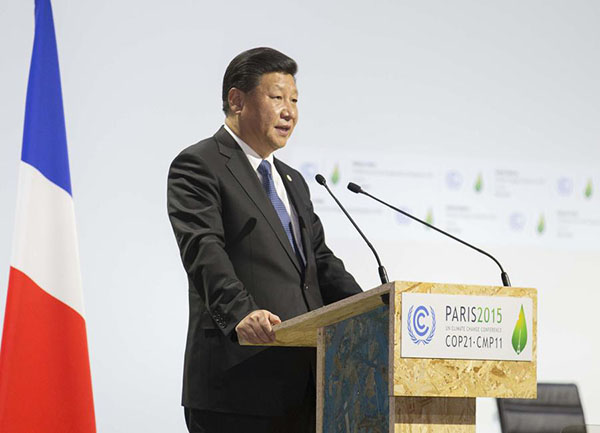
President Xi Jinping delivers a speech for the opening day of the World Climate Change Conference 2015 (COP21) at Le Bourget, near Paris, France, November 30, 2015. [Photo/Xinhua] |
The principle of a "common but differentiated responsibility" should be highlighted in the upcoming UN Climate Change Conference in Paris in December, a stand that China has insisted on, said a commentary by Xie Zhenhua, China's special representative for climate change.
"Addressing climate change is in the core interests and benefit of all nations, and also an issue that is closely related to each country’s global impact, thus the actions and interactions from different countries are intense, Xie wrote in a recent People’s Daily article.
Conflict and divergence still exist on how to realize common yet differentiated responsibilities, such as how to fairly allocate each country’s share of capital and technological support and reach an agreement that is legally binding globally, wrote Xie.
Taking the excuse of a changed global economic order, some developed countries have proposed a new system whereby developing and developed countries shall make joint investments in reducing carbon emissions after 2020, a move that Xie said is aimed at safeguarding their own interests.
Xie pointed out the new system has blurred the responsibilities that developed and developing countries should shoulder and the system also fails to take into account the different capabilities of countries to tackle carbon emissions.
The ambiguous approach to historical responsibilities and differentiating present capabilities in tackling climate change would damage the existing international solidarity to combat the threat and should be avoided, wrote Xie.
Xie also said existing disputes in the practice of emissions reduction affect the agreement.
As some countries push for a sweeping and legally binding agreement for all countries to realize strict emissions reductions, other nations are seeking more tolerant and flexible reduction standards in which countries can decide on their own level of contributions without a legally enforceable commitment.
Xie argues that developing countries generally believe the agreement should insist on common but differentiated responsibilities, be fair and take into consideration each nation’s capacity to cope with the demands.
Developed countries shoulder greater historical responsibility for climate change and should take the lead in emissions reduction while providing developing countries with capital and technological support.
Developing countries also face other challenges, such as poverty reduction, improving living standards and environmental protection.
The legitimate right to develop should be safeguarded when developing countries tackle problems arising from the environment and climate, said Xie.
Developed countries have so far made limited progress in their commitments to reducing carbon emissions by 2020 and promising $100 billion annually to developing countries after 2020. This will be a huge challenge for the upcoming Paris conference, wrote Xie.

Copyright 1995 - . All rights reserved. The content (including but not limited to text, photo, multimedia information, etc) published in this site belongs to China Daily Information Co (CDIC). Without written authorization from CDIC, such content shall not be republished or used in any form. Note: Browsers with 1024*768 or higher resolution are suggested for this site.
License for publishing multimedia online 0108263 Registration Number: 130349