Comments
  Print
Print  Mail
Mail  Large Medium Small
|
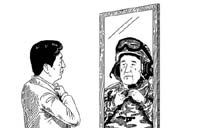 |
| Comment: Japan still disowns its dark past |
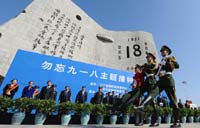 |
| Remembering a wound |
|
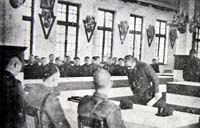 |
| Japan surrender site in E China |
More important still, the Chinese people through great sacrifices pinned down Japan's million troops on the Chinese battlefront so that it could not enhance its military forces in the Far East and the Pacific Ocean. As a result, it greatly reduced the pressure on the Allied forces. When the Pacific war broke out, Japan's military strength totaled 2.1 million soldiers, of which 1.4 million were sent to China.
At this time less than 400,000 Japanese soldiers were fighting on the several million-square-kilometer Pacific battlefield. Thus, 67 percent of the total Japanese military strength was tied up in China during the most dangerous period of the Pacific war.
In other words, the Japanese military force that China (one nation) resisted trebled that more than 10 nations headed by the United States resisted. The leaders of the Allies knew this well. Franklin D. Roosevelt, then US President, once commented that without China, or if China had been defeated, many more Japanese divisions would have been deployed to other areas and they would have been able to occupy Australia and India immediately without any trouble, and then push to the Middle East.
In the spring of 1942, the United States proposed to establish a China War Zone, and invited Chiang Kai-shek to be the supreme commander. The China War Zone consisted of the China proper, as well as Vietnam, Thailand, Burma (now Myanmar), etc., a clear indication that the Allies relied heavily on China.
Because of this, on New Year's Day, 1942, the United States, Britain and the Soviet Union united with China, and issued the United Nations Declaration. Thus, China became one of the four major anti-Fascist powers. In December 1943, China, Britain and the United States jointly issued the Cairo Declaration. It formulated the general principles of resistance against Japanese imperialists in the anti-Fascist struggle.
The Potsdam Proclamation was also jointly issued by Chinese, American and British governments in July 1945, and won wholehearted support worldwide. (The Soviet Union entered into it in August.)
It sounded the death knell for the international Fascist warmongers, at the same time becoming an official denunciation against the Japanese Fascists. China's prestige and influence not only frightened the Japanese warlords, but also won for it the respect of all those people who wanted to free themselves from under the iron heel of the Fascists.

 Chinese lose sleep as they aim to achieve goals
 Balancing an egg on end during vernal equinox
 Children receive treatment after eating rat poison
 Men can be good pole dancers
 Farmer builds own drones to spray crops
 Tank flattens phony fire fighting gear
 No common health ills for kids given drugs
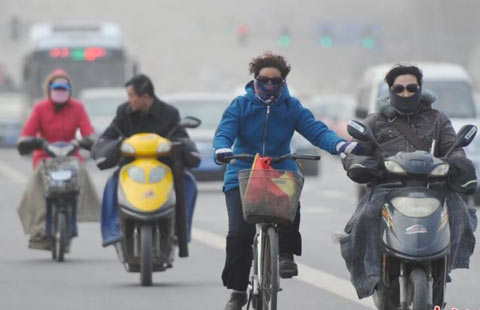 Sand storm hits Xinjiang
Copyright 1995 - . All rights reserved. The content (including but not limited to text, photo, multimedia information, etc) published in this site belongs to China Daily Information Co (CDIC). Without written authorization from CDIC, such content shall not be republished or used in any form. Note: Browsers with 1024*768 or higher resolution are suggested for this site.
License for publishing multimedia online 0108263 Registration Number: 20100000002731