X-lab nurtures the future for China, Germany


Twenty-nine-year-old Jan Milark sits deep in the corner of a 1,000-square-meter office, but he's easy to spot with his snow-white shirt and Caucasian face.
Milark started an online art business earlier this year and was attracted to the current office - an arm of Tsinghua University's X-lab - in October. The lab, in Zhongguancun, the heart of China's Silicon Valley, supports more than 900 entrepreneurial teams whose projects range from mobile internet and new materials to artificial intelligence.
"With the rising of the middle class, China will become the leading market for outstanding young artists from Europe and around the world," Milark says confidently. He graduated from Tsinghua University two years ago.
|
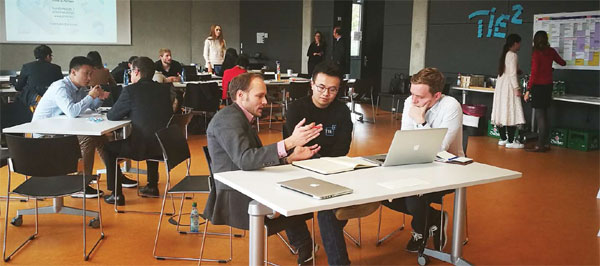
Students from China and Germany discuss their projects as a multinational team. Provided to China Daily |
Mao Donghui, executive director of the X-lab program, explains the mission:
"Talent is the foundation of innovation for the new economy. A new kind of education is key for training innovators. We hope to help students from home and abroad master the basics of innovation and creating business startups. These are the engine for the future."
China and Germany have cooperated in the areas of economics, culture and education in order to promote upgrades over the past decade. In June, China's National Development and Reform Commission and the German Federal Ministry of Economy and Energy hosted the eighth Sino-German Economic and Technical Cooperation forum.
And in June, Qian Yingyi, dean of the Tsinghua University School of Economics and Management, signed a memorandum of understanding with Helmut Schoenenberger, CEO of the innovation center at Technical University of Munich, calling for collaboration between German and Chinese startups. It covers student exchanges, education sharing and creating and Tsinghua's X-lab is closely involved.
"We will promote in-depth cooperation for students from both countries and explore new models of international innovation and entrepreneurship education," Mao says.
Tsinghua's X-lab, founded in 2013, aims to lighten the burden of creativity for undergraduates and to provide basic training and support. "X" means exploration of the unknown, as well as discipline and integration. The word "lab" reflects learning through practical experience and teamwork.
As of the end of October, more than 20,000 students had participated in lectures, competitions, exchanges and activities organized by X-lab. Some 943 programs launched by Tsinghua students and alumni joined the lab, whose registered financing has exceeded 1 billion yuan ($145 million; 137 million euros; 115 million). And they created more than 5,000 working positions, according to Emily Wang, information officer of X-lab.
Mao says 14 entrepreneurial teams from China and Germany applied to join the bilateral program this year. Students from both countries conduct market explorations while networking and participating in cultural exchanges.
"They set up temporary multinational teams and learn from field work to look for practical solutions by themselves. This is the most valuable experience for them."
The trip to Germany allowed students to communicate with local IT and law experts, helping them understand how to enter the European market, says Zheng Qi, senior director from international program of X-lab. She says some students even planned to launch their services in Germany and China in the near future.
According to Mao, the project will be held every year in Munich and Beijing to benefit more German and Chinese students. X-lab will also seek cooperation with other major universities in other countries to cultivate a global vision for the future entrepreneurs.
"The partnership between the X-lab entrepreneurship center and innovation of Technical University of Munich not only adds vitality to the Sino-German cooperation but also helps cultivate innovative international enterprises for both countries," German Ambassador to China Michael Clauss wrote in a letter to Qiu Yong, president of Tsinghua University.
wuyong@chinadaily.com.cn