 |
|
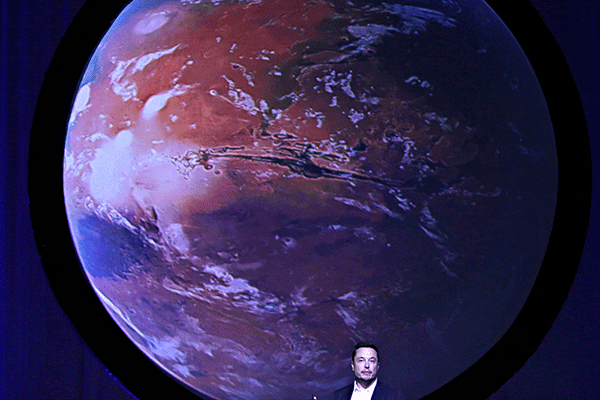
File photo shows SpaceX CEO Elon Musk unveils his plans to colonize Mars during the International Astronautical Congress in Guadalajara, Mexico, September 27, 2016. [Photo/Agencies] |
WASHINGTON - Astronauts traveling to Mars might be at risk of long-term brain damage and even dementia due to galactic cosmic ray exposure, a new study said Monday.
To explore a phenomenon called "space brain," researchers from the University of California, Irvine (UCI) exposed rodents to highly energetic charged particles -- fully ionized oxygen and titanium -- at the NASA Space Radiation Laboratory at New York's Brookhaven National Laboratory.
These particles are much like those found in the galactic cosmic rays that will bombard astronauts during extended spaceflights, according to the study published in the journal Scientific Reports, which is part of NASA's Human Research Program.
Six months after exposure, the researchers still found significant levels of brain inflammation and damage to neurons, said Charles Limoli, professor of radiation oncology in UCI's School of Medicine.
Imaging revealed that the brain's neural network was impaired through the reduction of dendrites and spines on these neurons, disrupting the transmission of signals among brain cells.
These deficiencies were parallel to poor performance on behavioral tasks designed to test learning and memory.
In addition, the Limoli team discovered that the radiation affected "fear extinction," an active process in which the brain suppresses prior unpleasant and stressful associations, as when someone who nearly drowned learns to enjoy water again.
"This is not positive news for astronauts deployed on a two-to-three-year round trip to Mars," Limoli said.
"The space environment poses unique hazards to astronauts. Exposure to these particles can lead to a range of potential central nervous system complications that can occur during and persist long after actual space travel -- such as various performance decrements, memory deficits, anxiety, depression and impaired decision-making. Many of these adverse consequences to cognition may continue and progress throughout life."
As a partial solution, Mars-bound spacecraft could be designed to include areas of increased shielding, such as those used for rest and sleep, Limoli noted.
However, these highly energetic charged particles will traverse the ship nonetheless, he added, "and there is really no escaping them."
Limoli's group is also working on preventive treatments involving compounds that scavenge free radicals and protect neurotransmission.

Copyright 1995 - . All rights reserved. The content (including but not limited to text, photo, multimedia information, etc) published in this site belongs to China Daily Information Co (CDIC). Without written authorization from CDIC, such content shall not be republished or used in any form. Note: Browsers with 1024*768 or higher resolution are suggested for this site.
License for publishing multimedia online 0108263 Registration Number: 130349