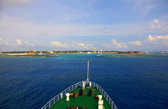
BEIJING ?-- The South China Sea seems unsettling, with the final award by an international arbitral tribunal approaching and heavyweight politicians and diplomats exchanging heated words.
High-level Chinese and US think tanks held a forum in Washington on Tuesday dedicated to the topic.
However, compared with turbulent regions in other parts of the world, where many face life-or-death situations daily, very little is actually happening in the Asian tropical waters.
Except, of course, frequent visits by US warships and fighters to the region in response to infrastructure upgrades by China within its territorial waters.
It raises the question whether resources and attention are wasted on something that should not be an issue.
China and the Philippines have had a dispute since the latter invaded and occupied islands and reefs belonging to China in the 1970s.
But the two countries have agreed to settle the disputes through bilateral negotiation. For years there were no serious confrontations worthy of international interference.
It was the Philippines that unilaterally initiated the arbitration on the disputes in 2013. The Chinese government has every right not to accept or participate in the arbitration.
For one reason, the arbitration proceeding under the United Nations Convention on the Law of the Sea (UNCLOS) does not apply to disputes such as the one between China and the Philippines in the South China Sea.
Also, why go international when the two sides have not exhausted means to negotiate between themselves? There are plenty of precedents that show introducing a third party only complicates things.
In the South China Sea, a third party is never a buffer, but only an accelerator of tensions.
The United States, which is an ocean away, practically invited itself in the name of freedom of navigation and flight. This notion is hardly justified, since more than 100,000 vessels from various countries sail through the South China Sea without incident every year.
It is wise to foresee a risk and prevent it from happening. But the United States' meddling in the South China Sea is more like a self-fulfilling prophecy, born out of dark motives to insert itself in power plays in East Asia.
Whatever its Asian strategy, the United States would not want the situation to grow out of control and become a real confrontation with China, nor is that China's intention. But China will not back down on sovereignty and territorial integrity.
Last month, US Defense Secretary Ash Carter said the arbitration panel's ruling would be "an opportunity for China and the rest of the region to recommit to a principled future, to renewed diplomacy, and to lowering tensions, rather than raising them."
Mr. Carter has put his hope in the wrong place. It is not Beijing, or The Hague, or the Nansha Islands, but Washington where he should look for changes.