 |
|
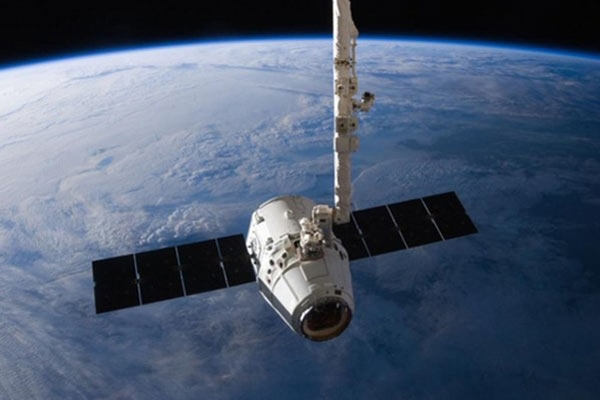
The SpaceX Dragon cargo capsule approaches the International Space Station prior to installation in this NASA picture taken April 10, 2016. [Photo/Agencies] |
WASHINGTON -- SpaceX's Dragon cargo ship arrived at the International Space Station (ISS) on Sunday, carrying an experimental inflatable space habitat that might be crucial for future deep space explorations.
The spacecraft was successfully captured at 7:23 a.m. EDT (1123 GMT) by European astronaut Tim Peake, using the orbiting lab's robotic arm, with help from US astronaut Jeff Williams, the US space agency NASA said.
Another US commercial cargo ship called Cygnus has been attached to the station since March 26. Two Russian Soyuz crew capsules and two Progress cargo ships are also docked at the moment. As a result, "Dragon' s arrival marks the first time two commercial cargo vehicles have been docked simultaneously at the space station," NASA said.
"With the arrival of Dragon, the space station ties the record for most vehicles on station at one time -- six." said NASA.
The last time six vehicles were docked to the station was back in the space shuttle era, when Discovery visited in February 2011.
Among the almost 7,000 pounds (3,200 kilograms) of items onboard Dragon is the 3,100-pound (1,400-kilogram) Bigelow Expandable Activity Module (BEAM), a 17.8-million-US-dollar project that will test the use of an inflatable space habitat in micro-gravity.
BEAM is expected to be filled with air to expand four and a half times its original volume at the end of May after being attached to the ISS.
During its two-year test mission, astronauts will enter the module for a few hours several times a year to retrieve sensor data and assess conditions.
BEAM measures 5.7 feet (1.7 meters) long and 7.75 feet (2.4 meters) when packed, and 12 feet (3.7 meters) long and 10.5 feet (3.2 meters) in diameter when expanded, with 565 cubic feet (16 cubic meters) of interior volume.
Inflatable habitats are designed to take up less room on a rocket, but provide greater volume for living and working in space once expanded, NASA said, noting that this test allows investigators to gauge how well the expandable habitat protects itself against solar radiation, space debris and contamination.

Copyright 1995 - . All rights reserved. The content (including but not limited to text, photo, multimedia information, etc) published in this site belongs to China Daily Information Co (CDIC). Without written authorization from CDIC, such content shall not be republished or used in any form. Note: Browsers with 1024*768 or higher resolution are suggested for this site.
License for publishing multimedia online 0108263 Registration Number: 130349