 |
|
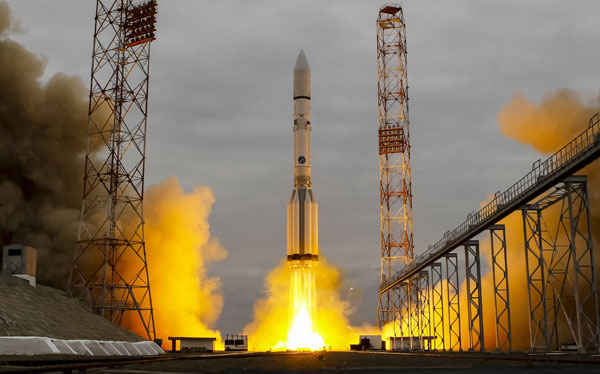
The Proton-M rocket, carrying the ExoMars 2016 spacecraft to Mars, blasts off from the launchpad at the Baikonur cosmodrome, Kazakhstan, March 14, 2016.[Photo/Agencies] |
The craft, part of the ExoMars programme, blasted off from the Baikonur spaceport in Kazakhstan on board a Proton rocket, starting a seven-month journey through space.
It carries an atmospheric probe that is to study trace gases such as methane -- a chemical that on Earth is strongly tied to life -- that previous Mars missions have detected in the planet's atmosphere.
"Why are we so interested in Mars? We are trying to understand how life originated in our solar system," Pascale Ehrenfreund, chair of German space agency DLR's executive board, said at a launch event held by the European Space Agency.
Scientists believe the methane could stem from micro-organisms, called methanogenes, that either became extinct millions of years ago and left gas frozen below the planet's surface, or that some methane-producing organisms still survive.
Another explanation for the methane in Mars's atmosphere could be that it is produced by geological phenomena, such as the oxidation of iron.
The spacecraft will deploy a lander that will test technologies needed for a rover due to follow in 2018, one step in overcoming the practical and technological challenges facing possible future human flights to Mars.
"I'm sure in 20 years or 30 years the moment will come when humans will go to the planet," Thomas Reiter, director of Human Spaceflight and Robotic Exploration at the European agency, said.
EARLY LIFE?
The second part of the ExoMars mission in 2018 will deliver a European rover to the surface of Mars. It will be the first with the ability to both move across the planet's surface and drill into the ground to collect and analyse samples.
"If there was early life it could have found refuge in the sub-surface, and the methane could be connected to that," ExoMars project scientist Jorge Vago said.
Landing on Mars is a notoriously difficult task that has bedevilled nearly all of Russia's previous efforts and has given U.S. agency NASA trouble as well. The United States currently has two operational rovers on Mars, Curiosity and Opportunity.
The cost of the ExoMars mission to the European Space Agency, including the second part due in 2018, is expected to be about 1.3 billion euros ($1.4 billion). Russia's contribution comes on top of that.
($1 = 0.9060 euros)
Copyright 1995 - . All rights reserved. The content (including but not limited to text, photo, multimedia information, etc) published in this site belongs to China Daily Information Co (CDIC). Without written authorization from CDIC, such content shall not be republished or used in any form. Note: Browsers with 1024*768 or higher resolution are suggested for this site.
License for publishing multimedia online 0108263 Registration Number: 130349