TOKYO - Japanese Prime Minister Shinzo Abe on Wednesday confirmed his intentions to amend a key clause of Japan's constitution that would further broaden the operational scope of the nation's Self-Defense Forces (SDF), following the passage of controversial legislation last year.
|
 |
|
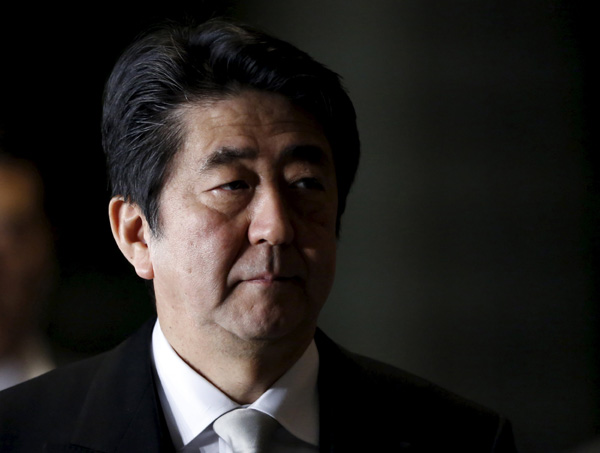
Japan's Prime Minister Shinzo Abe walks into his official residence in Tokyo, Japan, January 28, 2016. Japanese Economy Minister Akira Amari resigned abruptly on Thursday to take responsibility for a political funding scandal that has rocked the government, but denied having taken bribes.??[Photo/Agencies] |
In a response to a question by Tomomi Inada, the chairwoman of the LDP Policy Research Council, on the topic, Abe said that revising the constitution and, specifically, the war-renouncing Article 9 clause that prohibits Japan from maintaining armed forces with war potential, would better fit current realities.
While stating that elements of the particular clause in the constitution are contradictory, Abe said, citing a revision already drafted by his ruling Liberal Democratic Party (LDP), that the second paragraph of the clause mentioning, "Land, sea, and air forces, as well as other war potential, will never be maintained," should be revised.
"There is the view that Japan should address the situation in which 70 percent of Constitutional scholars suspect the SDF is in violation of the Constitution," the prime minister said.
"Given the view that we should change this with our own hands, the LDP has announced a draft revised Constitution," Abe added.
Addressing a lower house budget committee, the hawkish leader, who has since his first term in office been a strong advocate of amending the constitution, said that as the national charter was created during the United States' post-war occupation of Japan in 1947, elements of it "do not fit into the realities of the current period."
Abe said he believes the public's support for the Self-Defense Forces is "unshakable," in stark contrast to mass national protests last year following his cabinet's reinterpretation of the constitution and the ruling bloc's forced passage of contentious security legislation through both parliamentary caucuses.
He said he will make amending the constitution a key issue in this summer's upper house elections.
Japan's Supreme Law states that amendments to the constitution can be proposed by a two-thirds majority vote in Japan's bicameral parliament and thereafter be approved by the majority in a referendum.
The LDP at the moment holds a two-thirds majority in the more powerful lower house of parliament and a majority in the upper house.
The Initiatives from Osaka party, formed by former Osaka Mayor Toru Hashimoto, has indicated that it will back Abe's bid to win an outright majority in the upper house, so his constitutional amendment drive can be voted on in a national referendum.
Critics of Abe's legacy-led war campaign believe that the 70 years of pacifism enjoyed by Japan since the end of WWII could be compromised if the prime minister successfully amends the constitution and broadens the scope of Japan's SDF both regionally and internationally.
The potential of Japan's SDF shifting from a de-facto to bona fide military, with less constitutional constraints, and operating under a far-right wing government with openly revisionist policies regarding the whitewashing of the atrocities inflicted on countries occupied by the Imperial Army of Japan (IAJ) before and during WWII, has, naturally, unsettled countries in the region, who suffered at the hands of the IAJ during its brutal wartime reign.
The mass protests ahead of the passage of security bills last year, which, at the time, marked Japan's biggest security shift in its post war era, were also a clear indication that Japanese citizens are also opposed to the SDF's operational scope being broadened and against amending the war-renouncing Article 9 of the Japanese Constitution.
Many protestors at nationwide rallies feared that Japan could become embroiled in a conflict in support of its allies, making the island nation a target for retribution.
Others voiced concerns that Japan beefing up its military could lead to other nations in the region following suit and unnecessarily escalating regional tensions.