 |
|
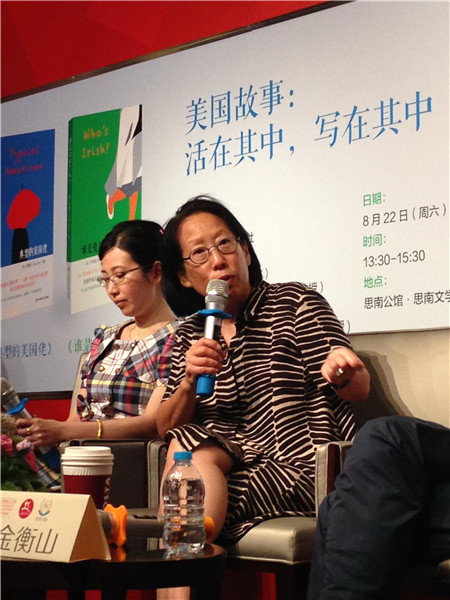
American writer Gish Jen. [Photo/China Daily] |
In Shandong, for the first time she heard expressions such as xiangbanfa (find a solution) coming from people other than her father, she says. She then began to think about what it was to be American, about how to understand the US and China, and the need to explain to Americans that people like her, even with a Chinese face, are just as American as anyone growing up on a farm eating apple pie.
"All these things, since I started studying writing, influenced Typical American."
That novel, published in 1992, was also inspired by misunderstandings about her identity, she says.
She married a Caucasian, and they had a daughter with a fair complexion. She also employed a German au pair who was more than 1.8 meters tall.
"So when we went out, people would think I was the nanny. They asked me, 'Do you have free hours?' I said, 'Eh? I am the mother'."
"That was the amiable irritant. That kind of experience made me think it's something I can write about."
Jen says she was often driven by the desire to make the world right.
"I thought, 'When my daughter grows up I want this problem to be over. I don't want her to grow up in a world where people will ask her similar questions. So it's my job to write a novel to provoke conversation, perhaps to bring about change."
As a second-generation Chinese-American she was well placed to reflect on questions of American identity and what the American dream is in the country's great melting pot.
At the start of Typical American, the three characters, first-generation Chinese-Americans, mock American whites, but after years living in the US their identities gradually change and they turn into "typical Americans".
"The reason that I emphasized American identity in my book is that I wanted to redefine the word American. If you started asking questions like what is Italian-American, Korean-American, Brazilian-American, then, I dare say, you are American."
Jen, who has also written about Jewish-Americans and Cambodian-Americans, says her job as a writer is not only to raise questions, but also to supply words for people to understand questions.
"Perhaps when you read about someone who has conflicts similar to yours, you'll realize that you're not alone. It enables you to grasp it. It's not my job to solve the problems. You have to solve them yourself. Whether you can solve them or not, at least you will have a better understanding of them.
"I also think about what is missing from the conversation. If I can most usefully add something I will try."
She is now working on a work of nonfiction, trying to explain Chinese culture to Americans.
"If they read my book and feel they understand a little more, then I've done my job."
Related Stories
Copyright 1995 - . All rights reserved. The content (including but not limited to text, photo, multimedia information, etc) published in this site belongs to China Daily Information Co (CDIC). Without written authorization from CDIC, such content shall not be republished or used in any form. Note: Browsers with 1024*768 or higher resolution are suggested for this site.
License for publishing multimedia online 0108263 Registration Number: 130349