Abe at Asian-African Summit but betrays Bandung Spirit
Updated: 2015-04-24 17:22
(Xinhua)
Comments Print Mail Large Medium Small
 |
|
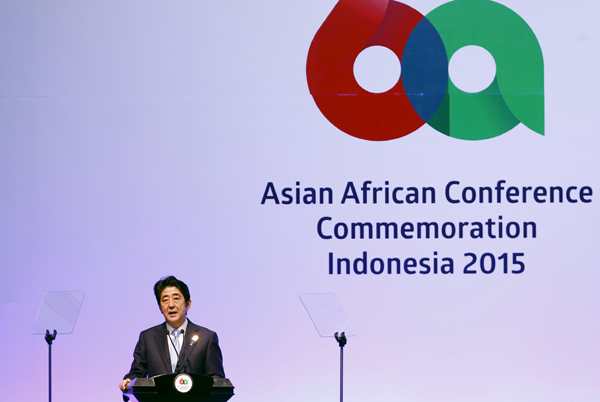
Japan's Prime Minister Shinzo Abe delivers a speech at plenary session during the Asian African Conference in Jakarta, April 22, 2015. The 60th Asian-African Conference is held in Jakarta and Bandung from April 19 to 24, 2015. [Photo/Agencies] |
BANDUNG, Indonesia - Japanese Prime Minister Shinzo Abe, after a brief tour to Jakarta, hastily returned to Tokyo on Thursday, possibly in preparation for his Washington visit two days later.
Abe seems in hurry for his US lobby mission which is likely to highlight the so-called "active pacifism" to boasting an ambition for "the greater dedication" which Japan is keen to bring about under his leadership.
The "active pacifism" is dubbed "militarized" by many analysts.
The Japanese prime minister cited "settlement of all international disputes by peaceful means" in his speech at the Asian-African Summit which ran here from April 22 to April 23.
The phrase was included in the ten Principles of Bandung and may have appealed to part of audience in Jakarta.
Abe said in his speech "Japan, with feelings of deep remorse over the past war, made a pledge to remain a nation always adhering to those principles throughout, no matter what the circumstances".
English copies of Abe's Jakarta speech were delivered to Chinese media promptly by officials of his delegation in a typical humble Japanese bowing manner.
However, Abe seemed intentionally shunning another item of the ten Principles, and that is "Abstention from the use of arrangements of collective defense to serve any particular interests of the big powers".
His core mission in Washington is to clinch the new Japan-US defense cooperation guidance in a bid to promote the Japan-US military alliance, dedicating more to the US interests.
The Japanese prime minister seemed far from the understanding of the Bandung Spirit, which unleashed the resentment of the Asian- African people towards imperial powers and the Cold War psychology.
Asian and African leaders gathered in Jakarta and Bandung to urge for a more fair, justifiable and reasonable world order.
This is a call which Abe and his friends bearing the same Cold War nostalgia could hardly understand.
The international community has witnessed Abe's heavier reliance on the Japan-US alliance and his emotional reactions to the China-initiated Asian Infrastructure Investment Bank.
He and his ally might be just too obsessed with the Cold War nostalgia.
In his Jakarta speech, Abe used the word "remorse" but failed to apologize for Japan's wartime atrocities and aggression.
The ten Principles of Bandung mentioned imperialism and colonialism.
Would Abe have the sincerity for remorse, he should have acknowledged that Japan was the invader during World War II. He would have used the Asian-African Summit as a platform to deliver the deep, real apology as his predecessor Junichiro Koizumi did 10 years ago at the past version of the Asian-African Summit.
Japanese media reported that Abe, when discussing his Jakarta speech ahead of the summit, showed allergy to the expressions of imperialism and colonialism which demonstrated his reluctance to inherit former Prime Minister Tomiichi Murayama 's Statement on Aug. 15, 1995 in which he apologized for the damage and suffering caused by Japan to its Asian neighbors during its aggression.
It was a regret for Japan as it lost an opportunity to face the history and soothe the neighbors'concern.
Following Abe's reserved remorse at the Asian-African Summit on April 22, his three female cabinet ministers visited the notorious Yasukuni Shrine one day later, an apparent provocation to the Bandung Spirit which highlights justice.
Abe is soon to hustle "peace" and "dedication" in Washington. He may brand his Jakarta speech as a successful image building, but to the victims of Japan's wartime atrocities, the shallow remorse would never ease their rage.
Related Stories
Abe's tepid offering of remorse at Asian-African summit bad omen for WWII anniversary statement 2015-04-23 09:54
Xi meets Abe in Jakarta 2015-04-22 19:13
Japan's ex-PM Murayama criticizes Abe's statement on apology 2015-04-22 16:24
Abe expresses 'deep remorse' over war without mentioning responsibility 2015-04-22 14:44
Schedule
Chinese President Xi Jinping will visit Pakistan and attend the Asian-African Summit and activities commemorating the 60th anniversary of the Bandung Conference in Indonesia from April 20 to 24.
April 22
Attend the opening ceremony of the Asian-African Summit;
Meeting with Indonesian President Joko Widodo;
April 23
Bilateral meetings;
Attend the closing ceremony of the Asian-African Summit;
April 24
Historical walk from Savoy Homann Hotel to Gedung Merdeka;
Attend activities commemorating the 60th anniversary of the Bandung Conference;

Feature