Abe's tepid offering of remorse at Asian-African summit bad omen for WWII anniversary statement
Updated: 2015-04-23 09:54
(Xinhua)
Comments Print Mail Large Medium SmallTOKYO - Japanese Prime Minister Shinzo Abe on Wednesday expressed his "deep remorse" for some of Japan's atrocities during Word War II, but he eschewed referencing key phrases from previous war statements.
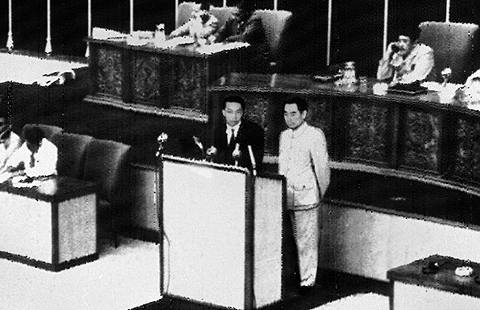
Addressing a summit of Asian and African leaders as part of events to commemorate the 60th anniversary of the Asian-African Conference, also known as the Bandung Conference, the Japanese leader stopped short of mentioning key words and phrases that have become synonymous with Japan's internationally-accepted war statement.
This year marks the 70th anniversary of the end of WWII and in August Abe will make a statement based on this most auspicious occasion and the statement has been attracting a great deal of attention from Japan's neighbors, who were brutalized by Japan's Imperial Army during WWII.
China and South Korea, which both suffered immeasurably, have been watching the build-up to Abe's statement, along with the rest of the world, with great interest. The 70th anniversary of the end of WWII this summer comes at a time when Japan's revisionist take on history and tendency to whitewash its wrongdoings.
In addition, certain factions have flat-out denied the historically irrefutable occurrences of travesties inflict by Imperial Japan on its victims, such as the "comfort women" and the Nanjing Massacre.
In Jakarta, Japan's leader said Japan, with feelings of "deep remorse" over the past war, pledged to always adhere to those very principles throughout.
But there were some expressions conspicuously absent from Abe's speech that could represented an ominous omen for his actual war speech on the day of the anniversary. Historically, Japanese leaders have used the Bandung Conference as a prelude to test-run their upcoming war statements.
In which case, Abe has deliberately chosen to use the phrase "deep remorse," but omitted the phrases "heartfelt apology to the people of Asian nations affected by Japan's colonial rule and aggression" during and before the war.
These phrases were introduced by then Prime Minister Tomiichi Murayama on Aug 15, 1995, to mark the 50th anniversary of the war's end and became a benchmark of Japan's apology to its neighbors and the world for its heinous wartime, militaristic actions.
The content of this speech was repeated verbatim by then Prime Minister Junichiro Koizumi during his statement on the 60th anniversary of the end of WWII, which has become the Japanese government's modus operandi.
Related Stories
Abe wants to avoid mentioning 'aggression' in history 2015-04-23 09:37
China's president meets Abe in sign of thawing relations 2015-04-23 08:29
Xi meets Abe in Jakarta 2015-04-22 19:13
Japan's ex-PM Murayama criticizes Abe's statement on apology 2015-04-22 16:24
Abe expresses 'deep remorse' over war without mentioning responsibility 2015-04-22 14:44
Schedule
Chinese President Xi Jinping will visit Pakistan and attend the Asian-African Summit and activities commemorating the 60th anniversary of the Bandung Conference in Indonesia from April 20 to 24.
April 22
Attend the opening ceremony of the Asian-African Summit;
Meeting with Indonesian President Joko Widodo;
April 23
Bilateral meetings;
Attend the closing ceremony of the Asian-African Summit;
April 24
Historical walk from Savoy Homann Hotel to Gedung Merdeka;
Attend activities commemorating the 60th anniversary of the Bandung Conference;

Feature