 |
|
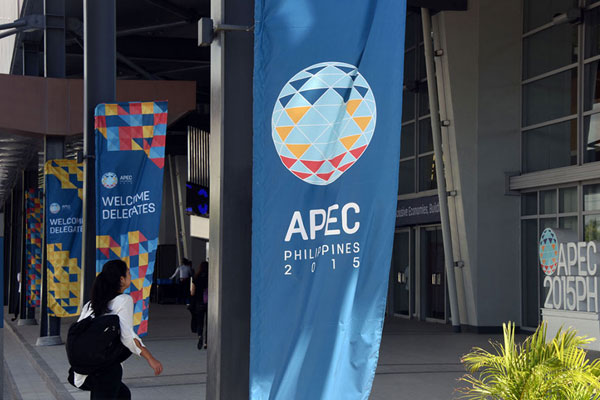
The 2015 Asia-Pacific Economic Cooperation Economic Leaders' Week hosted by the Philippines began in Manila on Friday. [Photo/IC] |
MANILA -- Leaders of 21 Pacific Rim economies are to gather here this week under the theme of "Building inclusive economies, building a better world."
From Beijing to Manila, the proposals and pragmatic moves of China have significantly boosted confidence in the Asia-Pacific economy and added vigor and vitality to regional economic integration.
The leaders of the Asia-Pacific Economic Cooperation (APEC) organization members reached broad consensus on economic integration, innovation and connectivity of the Asia-Pacific region in Beijing one year ago.
The 22nd APEC Economic Leaders' Meeting, held last November in Beijing, yielded tangible results.
It launched the process of the Free Trade Area of the Asia-Pacific; promoted innovation, reforms and growth to seek new momentum for the Asia-Pacific's long-term development; and blueprinted comprehensive inter-connectivity in the region.
Furthermore, China announced then the investment of $40 billion in establishing the Silk Road Fund to boost regional inter-connectivity.
The establishment of the fund, as part of the "Belt and Road" initiative (the initiative on the construction of the Silk Road Economic Belt and the 21st Century Maritime Silk Road) proposed by China, gave a huge boost to confidence building among regional economies.
"It isn't an APEC initiative; it's a Chinese government's initiative. But it's very much in line with what we are trying to do," said Alan Bollard, executive director of the APEC Secretariat.
He believed the initiative could mean physically connecting trade routes and facilitating the flow of goods, services, and human resources.
One year has elapsed since the Beijing gathering, and tangible progress has been made in implementing those proposals.
In the progress report released earlier this month, the Chinese government said, "Some initiatives have been achieved, some have seen breakthrough, some are well underway, and some are in the pipeline."
The progress report said implementation of the Beijing outcomes, which contributed to developing inclusive economies and building a better world, also conforms to the theme of APEC 2015.
Apart from the APEC agendas, wide-ranging progress has also been achieved in China's opening up and economic development reforms.
Achievements made in the implementation of the Belt and Road Initiative, the setting up of the Asian Infrastructure Investment Bank (AIIB), as well as outlines set in China's 13th Five-Year Plan (2016-2020) for national socioeconomic development, all helped enhance confidence building among regional economies.
China's growth will continue to outpace the global average and China's development and urbanization process will continue to "forge new markets, new opportunities for exchange and new knowledge economies," said Stuart Gulliver, group chief executive of HSBC Holdings.
He noted that China's 13th Five-Year Plan is expected to give support to companies in information technology, the environmental sector, agriculture, healthcare, medical apparatus and education.
These are "all areas in which Australia has ready-made expertise," Gulliver said on Nov. 7 in Australia.
Headway made in implementing the Belt and Road Initiative deserves regional and global attention, according to Wang Lili, a member of the APEC China Business Council.
Wang said the Belt and Road Initiative has already activated 300-400 billion Chinese yuan or RMB (47-62.8 billion dollars) in investment, offering vast opportunities for infrastructure inter-connectivity, E-commerce, and the energy sector.
APEC economic leaders will meet here on Wednesday to discuss ways toward more inclusive economies, with deliberations around financial integration, fiscal reforms and transparency, financial resilience, and infrastructure development, according to Gil Beltran, finance undersecretary of the Philippines.
On the topics set to be discussed in Manila, China will also have constructive proposals and contributions to share, especially after the establishment of the AIIB and the gradual advance of the RMB's internationalization.
The Chinese proposals will not only boost confidence building in the APEC community, which covers 40 percent of the world's population and produces 57 percent of the global gross domestic product, but will also provide rich cooperation opportunities for individual APEC members.
In a recent interview with Xinhua, former Philippine President Joseph Estrada said the Philippines needs China's help in infrastructure construction so as to modernize the country.
"It is necessary for the Philippines to join the Asian Infrastructure Investment Bank. I hope China will help us," said Estrada, who is also mayor of Manila.

Copyright 1995 - . All rights reserved. The content (including but not limited to text, photo, multimedia information, etc) published in this site belongs to China Daily Information Co (CDIC). Without written authorization from CDIC, such content shall not be republished or used in any form. Note: Browsers with 1024*768 or higher resolution are suggested for this site.
License for publishing multimedia online 0108263 Registration Number: 130349