Q:?How did?the CPC launch the First Strategic Counter-Offensives in the China Theater?
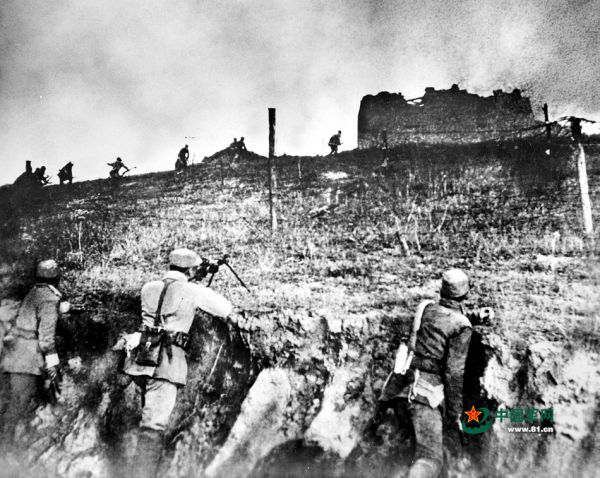
A: Beginning in the fall of 1943, the Japanese Army gradually lost its grip over its rear lines in northern China, whereas the Eighth Route Army, whose strength was increasing, enjoyed superiority in some areas and was the ?rst Chinese army to launch offensives against the Japanese, paving the way for strategic counter-offensives in the China Theater.
In July 1943, with the support of Japanese troops, the collaborationist Provisional 24th Group Army occupied the seat of Lin County and its neighboring areas in the Eighth Route Army’s Taihang Resistance Base as well as areas south of the Wei River in the Hebei-Shandong-Henan Resistance Base. To thwart the enemy’s attempt to expand south into the Taihang Mountains and to defend the resistance base area, the Hebei-Shandong-Henan Military Area and the 129th Division, which constituted the Taihang Military Area, launched two campaigns.
On July 30, the Hebei-Shandong-Henan Military Area’s main force launched the first campaign south of the Wei River and attacked the collaborationist troops that had invaded Changyuan and Hua counties. Most of the invading troops were eliminated, and those remaining retreated to the areas west of the Wei River. By mid-August, the campaign was successfully concluded, with the Eighth Route Army eliminating more than 5,600 Japanese and collaborationist troops and recovering and developing the areas south of the Wei River.
On August 18, the second campaign was launched into southern Lin County. The 129th Division concentrated the main forces of the Taihang Military Area and the Southern Hebei Military Area to form east and west operation groups, which set off on an offensive against Japanese and collaborationist troops who had invaded Lin County and its surrounding areas. The campaign came to an end on August 27, with the Eighth Route Army eliminating more than 7,000 enemy troops and liberating the vast territory south of Lin County and north of Hui County, which together contained a population of more than 400,000.
Following these two campaigns, the Eighth Route Army’s Shandong Military Area launched offensives into southern Shandong and Binhai in November 1943. On November 15, Southern Shandong Military Area forces attacked a unit of Liu Guitang’s collaborationist troops in and around Dongzhuzi Village in Fei County, eliminating more than 1,100 soldiers and seizing 12 strongholds. On November 19 and 20, Binhai Military Area forces embarked on the Ganyu Campaign, eliminating more than 2,000 collaborationist troops and over 10 strongholds. On December 4, the Central Shandong Military Area amassed about five regiments to attack Wu Huawen’s collaborationist troops in the Mount Lu area. After four days, more than 1,000 of Wu’s men had been eliminated and more than 20 strongholds had been taken over.
These campaigns show that to some extent, the Eighth Route Army had already seized the initiative in the battlefield and was capable of launching offensive operations. With conditions thus ripening, these campaigns would shortly be followed by even greater local counter-offensives.

Copyright 1995 - . All rights reserved. The content (including but not limited to text, photo, multimedia information, etc) published in this site belongs to China Daily Information Co (CDIC). Without written authorization from CDIC, such content shall not be republished or used in any form. Note: Browsers with 1024*768 or higher resolution are suggested for this site.
License for publishing multimedia online 0108263 Registration Number: 130349