Q: How did Japan surrender and what happened in acceptance ceremony in China?
A: At noon on August 15, 1945, a radio broadcast was aired throughout Japan in which Japanese emperor Hirohito read the Imperial Rescript on the Termination of the War, officially announcing unconditional surrender.
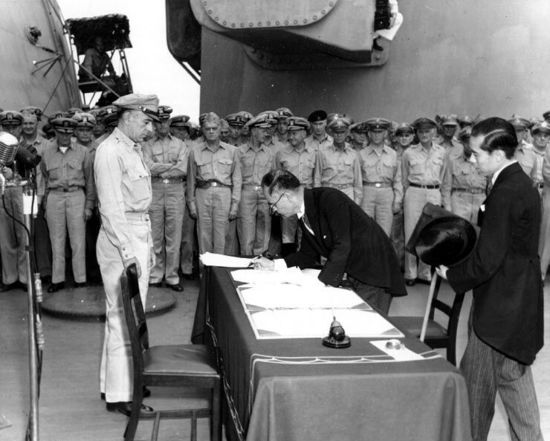
On September 2, 1945, a ceremony for Japan's surrender was held on board the USS Missouri anchored in Tokyo Bay. The Japanese Instrument of Surrender was signed by Japanese Foreign Minister Mamoru Shigemitsu on behalf of the Emperor of Japan and the Japanese Government and by Chief of the General Staff YoshijirōUmezu on behalf of the Japanese Imperial General Headquarters. Douglas MacArthur, Supreme Commander for the Allied Powers, signed the instrument, followed by the nine representatives of the Allied Powers that accepted the surrender: United States representative Admiral C. W. Nimitz, Chinese representative General Hsu Yung-Chang, United Kingdom representative Admiral Bruce Fraser, Union of Soviet Socialist Republics representative Lieutenant General KuzmaDerevyanko, and representatives of Australia, Canada, France, the Netherlands, and New Zealand.
With this, the thorough defeat of Japan's militarism and ?nal victory in the Global War against Fascism was officially proclaimed. September 3 was later established as the victory memorial day for the Chinese People's War of Resistance against Japanese Aggression.
On September 9, 1945, the signing ceremony for the Japanese armed forces' surrender in the China Theater was held at the ceremonial hall of the National Government's Central Military Academy in Nanjing.
At 08:52, Ho Ying-chin, Commander-in-Chief of the Chinese Army and the special representative for the Supreme Commander of the China Theater Chiang Kai-shek, as well as GuZhutong, Commander-in-Chief of the 3rd War Zone, Xiao Yisu, Chief of Staff of the Chinese Army Headquarters, Chen Shaokuan, Commander-in-Chief of the Navy, and Zhang Tingmeng, Commander of the 1st Air Force, entered the hall and were seated for the surrender acceptance ceremony.
Seven Japanese officers, including Yasuji Okamura, the Japanese representative for surrender in the China Theater and Commander-in-Chief of Japan's China Expeditionary Army, followed by Asasaburo Kobayashi, Chief of Staff, Takeo Imai, Deputy Chief of Staff, Ryozo Fukuda, Commander-in-Chief of the China Area Fleet, and HarukiIsayama, Chief of Staff of Japan's Taiwan Army, took off their caps and entered the hall.
At exactly 9am, Ho Ying-chin handed the Declaration of Japanese Surrender to Xiao Yisu who presented it to Okamura. After reading it, Okamura signed and stamped both copies of the Declaration and then gave them to Kobayashi to hand back to Ho Ying-chin. Ho Ying-chin then signed and stamped the Declaration, and with this, the surrender acceptance ceremony for the China Theater was over.
The China Theater accepted the surrender of one Japanese headquarters, three area armies, ten armies, 33 infantry divisions, one tank division, two air force divisions, and 41 independent mixed brigades, as well as guard division soldiers, garrison forces, and naval units; a total of more than 1.28 million Japanese soldiers.

Copyright 1995 - . All rights reserved. The content (including but not limited to text, photo, multimedia information, etc) published in this site belongs to China Daily Information Co (CDIC). Without written authorization from CDIC, such content shall not be republished or used in any form. Note: Browsers with 1024*768 or higher resolution are suggested for this site.
License for publishing multimedia online 0108263 Registration Number: 130349