Resilience and unity
 |
|
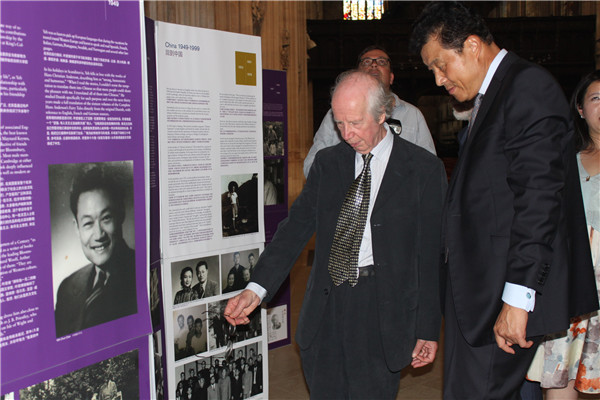
Professor Alan Macfarlane and China's ambassador to the United Kingdom Liu Xiaoming at the photographic exhibition dedicated to Ye Junjian's life and wartime work at the University of Cambridge. Peng Yining / China Daily |
During his trip, Ye endured the same tight rationing as his hosts - only 100 grams of tea and sugar and half a kilo of meat a month. "I have one egg every week. I always save the precious egg and enjoy it on a Sunday," he wrote in his diary.
He was deeply impressed by the resilience and unity of the British government and the people in their fight against the Third Reich. While most of the mobilized men were fighting in mainland Europe and elsewhere, the women worked in munitions factories, ran the transportation system and arranged the logistics for battlefield supplies.
Ye wrote that he was deeply impressed by the humor and fearless spirit of the British forces. He told the story of how he made a speech at a military airfield and later fell into conversation with some of the pilots. They told him that one of their comrades had failed to return after a sortie and was presumed to have been killed. One of the pilots simply shrugged and commented that it was "a poor show".
In his memoir, Ye wrote that he not only spread the story of China's resistance, but also learned a great deal about the British people and their lives, thoughts and ambitions.
"I also knew the strong empathy they felt for the Chinese people," he wrote. "Several times during my speeches people helped to hand out leaflets, and they voluntarily collected donations and gave them to the British China Aid Committee. It was very moving."
On Aug 15, 1945, Ye spent the evening preparing a speech at an Edinburgh hotel. He was just about to go to bed when he heard the sound of shouting in the streets below.
"I rushed downstairs and discovered that people were singing and dancing. Suddenly they spotted me, a young Chinese man. They ran over and kissed me on the cheeks. Some people lifted me up and cheered," he wrote. "It was then I realized that Japan had surrendered and World War II was officially over."
In recognition of his contribution to the war effort, the British Council awarded Ye a fellowship to conduct research into English literature at King's College, Cambridge.
He stayed at the university for four years, before returning to China in 1949. For the next 30 years he translated a wealth of European literature, including the fairy tales of Hans Christian Andersen. He died in 1999, at age 85.
"My father used to say: 'My whole life is about trying to make a little contribution to the mutual understanding and love between all nations', " said Ye Nianlun, his son. "He didn't leave a penny, but as one of his literary critics commented, 'Ye Junjian is a giant book, a rich treasure that has yet to be discovered'. "
Contact the writer at pengyining@chinadaily.com.cn

Copyright 1995 - . All rights reserved. The content (including but not limited to text, photo, multimedia information, etc) published in this site belongs to China Daily Information Co (CDIC). Without written authorization from CDIC, such content shall not be republished or used in any form. Note: Browsers with 1024*768 or higher resolution are suggested for this site.
License for publishing multimedia online 0108263 Registration Number: 130349