A providential meeting
|
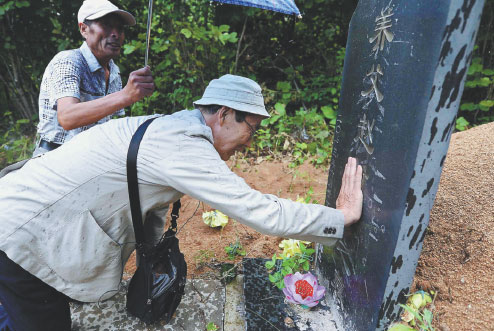
Chen Qinghe, a 73-year-old Japanese man abandoned by his parents during the hasty retreat at the end of World War II, kneels and weeps at the grave of his adoptive Chinese parents in Mudanjiang, Heilongjiang province, on Aug 11. Wang Kai / Xinhua |
In December 1994, Ikeda was drinking tea in a Tokyo cafe, when a 60-something woman asked if she could share the table. The woman became curious when she heard Ikeda's fluent Chinese, so Ikeda explained about her life as a Japanese war orphan in China. The woman responded with the story of her younger sister who had been left in Mudanjiang when her mother, herself and a sister returned to Japan.
The similarities in the stories excited the two women, and they both had DNA tests. The results, released in 1996, confirmed that they were indeed biological sisters.
It was then that Ikeda finally learned her own history.
Her father, a Japanese officer, had been stationed in China, but was captured and held as a prisoner of war in Siberia. Ikeda was born in May 1944, and the Japanese evacuation began when she was just 10 months old. Because the child was sickly, her mother felt she wouldn't survive the trip and begged a Chinese family take her. They agreed, but later sold the girl to another family, and she became Xu Ming.
Once Ikeda learned the truth, she changed her name for the third and final time, and her sisters took her to visit her parents' tomb in Ibaraki prefecture. Once there, her excitement began to give way to bitterness. "When I stood in front of the grave of my biological parents I couldn't help asking why I had been left behind," she said.
She realized that her apartment in Tokyo was only an hour's drive from her parents' final resting place, but it had taken her 15 years to cover the short distance between them.
"I guess it fate," she said.
As of March 2005, 6,286 "war orphans" had been permanently repattiated, according to the Japanese Ministry of Health, Labor and Welfare. Many found the transition traumatic. Some committed suicide because they were unable to speak Japanese and found it too difficult to settle down.
In 1982, Ikeda formed a support group to aid and advise war orphans - she is still active as its director-general - and a petition signed by 1.13 million people was presented to the Japanese parliament calling for better treatment of war orphans.
Although her life has been a prisoner of fortune, Ikeda remaions upbeat and positive. She is still grateful to her Chinese foster parents and China, and she donates funds to social projects, such as the construction of a school in Wenchuan, Sichuan province, after the area was devastated by an earthquake in 2008.
In just a few weeks, she will return to China as a guest of the Chinese government and will attend the celebrations being held to mark 70th anniversary of the China's victory over Japan. Maybe then, her quest for closure will finally be over.
Contact the writers at caihong@chinadaily.com.cn and shanyi@chinadaily.com.cn

Copyright 1995 - . All rights reserved. The content (including but not limited to text, photo, multimedia information, etc) published in this site belongs to China Daily Information Co (CDIC). Without written authorization from CDIC, such content shall not be republished or used in any form. Note: Browsers with 1024*768 or higher resolution are suggested for this site.
License for publishing multimedia online 0108263 Registration Number: 130349