 |
|
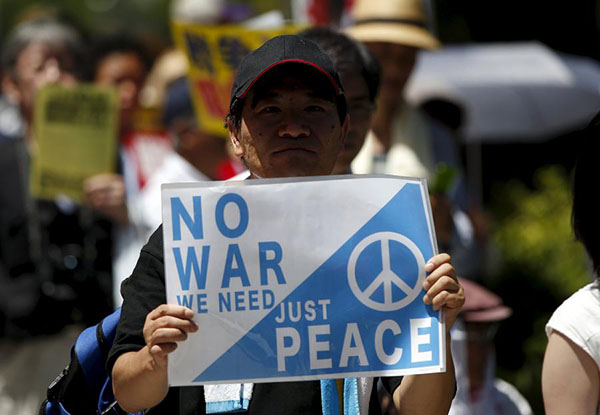
A protester holds a placard during a rally against Japan's Prime Minister Shinzo Abe's administration and his security-related legislation in front of the parliament building in Tokyo, July 15, 2015. [Photo/Agencies] |
TOKYO - Japanese Prime Minister Shinzo Abe will include the words "apology" and "aggression" in his statement marking the 70th anniversary of the end of World War II, NHK public TV said, an apparent nod to critics who fear he will dilute past apologies.
An initial draft did not include the word "apology", some media reports had said, which would likely anger China and South Korea where bitter memories of Japan's sometimes brutal past occupation and colonisation run deep.
Abe is juggling conflicting priorities in crafting the statement, expected to be approved by his cabinet one day before the Aug 15 anniversary. He needs to satisfy the desire of close ally the United States to ease tension in East Asia.
He also wants to maintain an incipient thaw in ties with China, as he eyes a summit with Chinese President Xi Jinping that one close aide said was likely in September.
However, the conservative Abe's core supporters want to end what they see as a humiliating cycle of apologies they say distracts from Japan's seven decades of post-war peace.
Abe has said he will uphold past statements about the war, including then-premier Tomiichi Murayama's 1995 landmark "heartfelt apology" for Japan's aggression and colonialism. But his previous remarks and stated desire to look to the future have raised concerns he wants to water down those apologies.
NHK said a draft of Abe's statement would refer specifically to the Murayama statement's key phrases "apology", "deep remorse", "aggression" and "colonial rule", but the broadcaster did not elaborate on the phrasing.
"While it appears that Abe is considering the inclusion of such key words in an attempt to pre-empt criticism both at home and from overseas, it seems possible, perhaps even probable, that he will significantly alter the context in which these words are used from the Murayama statement," said Sophia University political science professor Koichi Nakano.
"He might thus try to satisfy both his revisionist base and critics, but he might also simply anger both."
South Korean President Park Geun-hye said on Monday she wanted Abe's statement to clearly uphold past cabinets's views on wartime history "to show the Japanese government's mature attitude in trying to make a fresh start in relationships with neighbouring countries, including us."
Doubts persist over how Abe will refer to Japan's wartime military aggression, a term he has questioned in the past.
In a report last week, his advisers referred to Japan's "aggression" in China after 1931, although two dissenters objected to the term.

Copyright 1995 - . All rights reserved. The content (including but not limited to text, photo, multimedia information, etc) published in this site belongs to China Daily Information Co (CDIC). Without written authorization from CDIC, such content shall not be republished or used in any form. Note: Browsers with 1024*768 or higher resolution are suggested for this site.
License for publishing multimedia online 0108263 Registration Number: 130349