 |
|
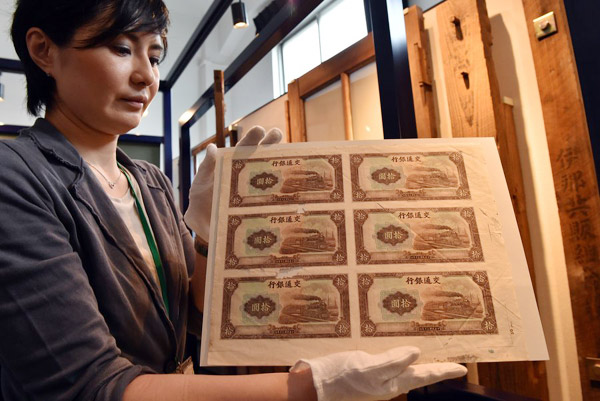
A staff member of Japan's Meiji University displays a sheet of counterfeit notes of China's Communication Bank from World War II at the museum of the Japanese Imperial Army's Noborito laboratory in Kawasaki, suburban Tokyo on May 29, 2015. Special weapons such as paper ballon bombs, fake Chinese banknotes, chemical and biological weapons were researched and produced at the Noborito laboratory of which some facilities remain in the university campus. [Photo/CFP] |
TOKYO - The Imperial Japanese Army used to secretly make weapons, such as balloon bombs and counterfeit money, during World War II in a laboratory in the central Kanagawa Prefecture. Those war crimes are recorded at the former army institute, now preserved as Meiji University's Noborito Peace Education Museum.
"It is the only museum in Japan focusing on clandestine warfare, which is a part of war but is rarely a part of recorded history," Curator Akira Yamada told Xinhua.
According to history archives, some 9,300 explosive balloon bombs were released from bases in Chiba, Ibaraki and Fukushima from November 1944 to April 1945.
"Those balloons made use of jet streams over the Pacific Ocean and could arrive in North America in 50-60 hours," Yamada said. However, only 1,000 balloons are estimated to have reached their destination, leaving 6 people dead in the U.S. state of Oregon.
"Initial plans were to load the balloons with biological weapons, such as the cattle plague virus, but this was changed to explosive bombs and incendiary bombs to not overly exasperate the Americans," said Yamada. He told Xinhua that "Some viruses developed by the Noborito Laboratory were tested in human experiments in Nanking, China, by Unit 731 and Unit 1644 jointly," both are notorious for their human experimentation.
"More than 10 people were actually killed through those experiments in order to test the poisons," Yamada said, quoting former worker Shigeo Ban's testimony.
Talking about the war against China, Yamada said the army institute was involved in not only biological weapons, balloon bombs, toxins among other confidential defense technology, but also fake money.
It printed around 4 billion yen's worth of counterfeit bank notes, with approximately 2.5 billion used to purchase supplies in China.
"The national budget for Japan in 1945 was only 20 billion yen, which meant the counterfeit bills are almost one-fifth of the total budget," Yamada said, adding that 4 billion yen at that time might be equivalent to 20 trillion yen (161.38 billion U.S. dollars) today.
"Although the money had limited effect to disturb China's economy, the Imperial Japanese Army did purchase plenty of supplies using the fake money," said Yamada.

Copyright 1995 - . All rights reserved. The content (including but not limited to text, photo, multimedia information, etc) published in this site belongs to China Daily Information Co (CDIC). Without written authorization from CDIC, such content shall not be republished or used in any form. Note: Browsers with 1024*768 or higher resolution are suggested for this site.
License for publishing multimedia online 0108263 Registration Number: 130349