Editor's note: This article is run by the Guardian, which, together with China Daily and other 32 global media, forms Climate Publishers Network.
India's announcement means all the world's biggest economies are now publicly in favour of a deal, but there are still challenges ahead
 |
|
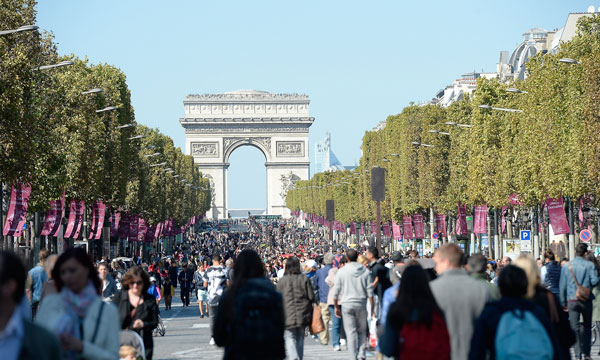
Crowds on the Champs Elysees during a car-free day in Paris, two months before climate change talks in the city Photograph: Aurelien Meunier/Getty Images |
With India's plan for curbing carbon emissions now in, most of the major developing economies have responded to the UN's requests for the commitments on climate change that will form the keystone of an agreement to be signed in Paris this December.
Those commitments – to make absolute cuts in future emissions levels, in the case of developed countries; to curb future emissions growth, in the case of less industrialised nations – will not add up to the cuts that scientists say are needed to avoid more than 2C of warming above pre-industrial levels. This is significant, because the 2C threshold is regarded as the limit of safety, beyond which the changes in the climate are likely to become catastrophic and irreversible.
On current commitments, warming is still likely to exceed 2C or even 3C , with potentially severe consequences in the form of an increase in extreme weather, heatwaves, droughts, floods and rising sea levels, that could wreak havoc across the globe.
But this is not the end of the story.
In Paris, governments are expected to sign up to a new global agreement on the climate that would come into effect from 2020, when current national commitments on emissions expire. But while world governments debate their role in avoiding dangerous warming, other commitments are also likely to be significant.
For instance, cities are expected to play an increasing part in driving down carbon dioxide emissions, and many of these commitments are not included in the national government targets. Businesses, too, are coming forward with plans to reduce their emissions, which could have a major impact. Paris is also not an end point but the beginning of a new process by which emissions could be ratcheted down in future, in the form of five-yearly reviews of targets.
Taken together, these factors could add up to enough to meet scientific advice in the coming decade.
India's announcement is an important step forward in climate diplomacy, too: the country was the only one to stand alongside China in 2011 in rejecting the UN roadmap that has led to the Paris talks.
Last year, China made a historic move by agreeing, at a meeting with US president Barack Obama, that it would cause its emissions to peak by 2030, the first time Beijing had set such a date.
India's pledge is less clear, with the centrepiece a commitment to derive 40% of its electricity from renewables and other low carbon sources. With its announcement, however, one of the last obstacles to a landmark agreement has now been cleared. All of the world's biggest economies are now publicly in favour of a deal in Paris, after French president Francois Hollande earlier said that a miracle would be needed to get agreement among nearly 200 countries.
With less than 60 days to go before the Paris conference, things could still fall apart. Just last month Hollande warned of the risk of failure.
Finance will be key. Developed countries agreed at the last landmark climate conference, in Copenhagen in 2009, that at least $100bn in financial assistance would be provided to poor nations annually by 2020 to help them cut emissions and cope with the effects of global warming. Evidence that this will happen has still not been formally accepted, though countries including the UK have recently stepped up their pledges of assistance.
There is also the vexed question of what should be the legal form of any Paris agreement, a subject likely to keep negotiators up late into the night at the conference, and some anxiety among the hosts over whether the text of a deal can be formulated in due time.
Any agreement will have to satisfy the poorest nations of the world, which have less economic power than India and China. They are likely to be the worst equipped to cope with climate change, and plans on how they will be helped to adapt are still in the making. The UN is the only forum in which the least developed countries have an equal voice with the richest, and they will have their say at Paris.
Copyright 1995 - . All rights reserved. The content (including but not limited to text, photo, multimedia information, etc) published in this site belongs to China Daily Information Co (CDIC). Without written authorization from CDIC, such content shall not be republished or used in any form. Note: Browsers with 1024*768 or higher resolution are suggested for this site.
License for publishing multimedia online 0108263 Registration Number: 130349