 |
|
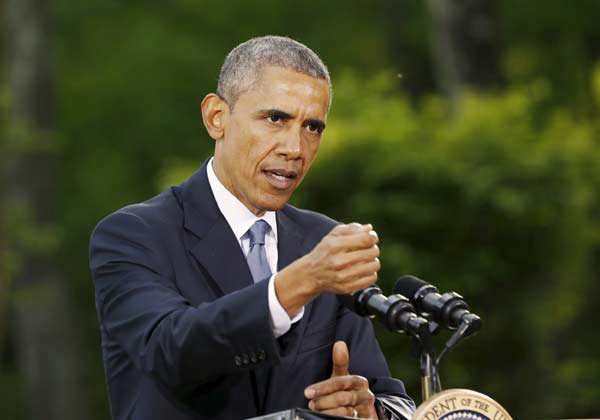
US President Barack Obama speaks during a news conference after hosting the six-nation Gulf Cooperation Council (GCC) at Camp David in Maryland May 14, 2015. [Photo/Agencies] |
WASHINGTON -- A major summit between the United States and the Gulf nations wrapped up Thursday with pledges of increased security cooperation, but fell short of producing a formal defense treaty sought by Gulf nations amid their concerns over a rising Iran and a possible nuclear arms race in the Middle East.
The meetings, held at the Camp David presidential retreat, were the first such talks in some time between the United States and the Gulf Cooperation Council (GCC), which includes Saudi Arabia, Bahrain, Oman, Kuwait, the United Arab Emirates and Qatar. They were also the first such talks after the United States reached a framework for an agreement on limiting Iran's nuclear program.
Critics blast the US deal with Iran as too soft on Iran, and Gulf states fear that the Islamic Republic could obtain nuclear weapons despite a deal intended to prevent this, although Tehran says its nuclear program is peaceful.
INDEPENDENT DEFENSE VIEW
The GCC countries are worried that the administration of US President Barack Obama is not as focused on the Middle East as much as leaders would like, leading some Gulf nations to take a more independent view of their own defense.
Indeed, Saudi Arabia has vowed to match what it believes to be Iran's nuclear capabilities. A recent New York Times article quoted former Saudi intelligence chief Prince Turki bin Faisal as saying, "Whatever the Iranians have, we will have, too."
Experts said the Saudis will take a more independent stance on their own defense.
"The Gulf states will take a more independent attitude to their defense, for example, acquiring nuclear technology," Simon Henderson, director of the Gulf and Energy Policy Program at the Washington Institute, told Xinhua.
Other experts said Obama is perceived by Middle Eastern leaders as withdrawing from the region as much as possible. James Phillips, a Middle East expert at the Heritage Foundation, said this has compounded the nervousness of Arab allies already worried about Iran.
"Saudi Arabia and other GCC states have upgraded relations with France as partial compensation, and are likely to seek better relations with Russia and China as an offset to Iran," he said.
Indeed, The New York Times reported Wednesday that France is plugging the gap between the United States and the Gulf states, noting that recently French President Francois Hollande oversaw a 7-billion-US-dollar deal to sell fighter jets to Qatar.
While the Gulf states did not get the military pact they were looking for, Obama used strong language Thursday to give Gulf leaders and officials assurances that the United States would be there when needed.
Copyright 1995 - . All rights reserved. The content (including but not limited to text, photo, multimedia information, etc) published in this site belongs to China Daily Information Co (CDIC). Without written authorization from CDIC, such content shall not be republished or used in any form. Note: Browsers with 1024*768 or higher resolution are suggested for this site.
License for publishing multimedia online 0108263 Registration Number: 130349