 |
|
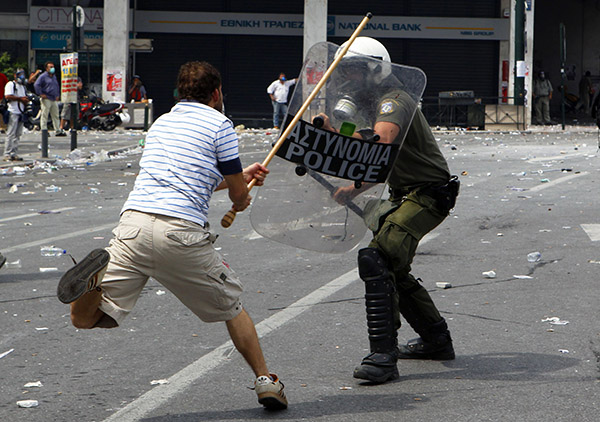
A protester clashes with a police officer in Athens' central Syntagma (Constitution) Square in this June 15, 2011 file photo. Greece triggered the regional financial crisis in 2009 when a far higher budget deficit than previously calculated emerged. The collapse of talks with creditors in Paris last November set off a month-long sequence of events leading to elections this week and proving Greece is still the region's weak link. The vote is expected to be won by Syriza, a far-left party opposed to the bailout, worrying investors and creditors alike. [Photo/Agencies] |
CRISIS IN THE MAKING
Despite Greece's sudden return to the spotlight, trouble had been brewing for Samaras's government since May.
The momentum ought to have been clearly in his favour: Greece had just returned to bond markets after a four-year exile, it had reported a primary budget surplus after decades and there were signs of an economic recovery.
But Greeks were hurting from four years of wage and pension cuts. Unemployment was over 25 percent. The economic malaise helped Syriza storm to victory in European elections in May.
A botched introduction of a new property tax over the summer further added pressure on the government. By early autumn, polls showed Syriza firmly ahead and the troika was demanding further pension reform and tax hikes to ensure a near balanced budget.
Samaras was convinced he would not get any more austerity measures passed in parliament, a government official said.
Hoping to wrest back the momentum, he announced in late September a surprise plan to exit the unpopular bailout programme a year ahead of schedule.
But talks with creditors didn't follow as he hoped. In mid-November, the two sides were growing further apart on the 2015 budget. The IMF and EU said Athens needed to find cost-cutting and revenue-raising measures for an extra 2.5 billion euros.
Greek government officials argued that they only needed to find additional cuts worth about 500 million euros.
They were infuriated by the lenders' request for a contingency reserve for emergency outlays to be beefed up to 1.2 billion euros from 1 billion euros the previous year, arguing that it flew in the face of an economic rule.
"This rule implies that in 2015, a year of high growth and declining risk, the contingency reserve ought to decline. Yet you assume the contingency reserve ought to rise by 200 million euros!" Finance Minister Gikas Hardouvelis wrote in a Nov. 29 document obtained by Reuters that Athens sent inspectors.
The lenders' stance suggested they wanted the extra money in case political uncertainty and elections further delayed reforms, knocking targets even further off track, Greek officials said.
"The (bailout) talks crossed paths with the presidential vote...leading us to a very tough situation," said Deputy Prime Minister Evangelos Venizelos. "We did the best we could."
 China's big train makers reunite in quest for overseas business
China's big train makers reunite in quest for overseas business

Copyright 1995 - . All rights reserved. The content (including but not limited to text, photo, multimedia information, etc) published in this site belongs to China Daily Information Co (CDIC). Without written authorization from CDIC, such content shall not be republished or used in any form. Note: Browsers with 1024*768 or higher resolution are suggested for this site.
License for publishing multimedia online 0108263 Registration Number: 130349