Chinese state-owned and private enterprises expected to make a big push
A scale weighing China's outward direct investments across the globe currently tilts heavily toward Asia, at a whopping 70 percent of total volume by 2013, most of which was poured into Hong Kong.
|
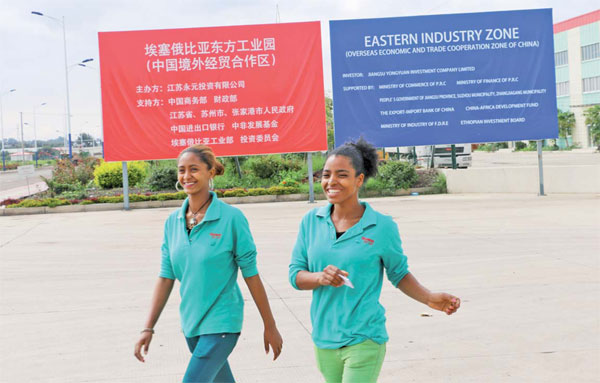
Two workers pass by a signboard of the Eastern Industrial Park in Ethiopia. There are 10 industrial parks being developed by Chinese investors in Africa. Chen Weihua / China Daily |
But with massive infrastructure projects being planned throughout Africa, such as new railway networks in East Africa and regional air routes at the heart of the continent, many experts, including Zhang Jianping, a director at the National Development and Reform Commission, believe China's investment in Africa is entering a new era.
"If these (infrastructure) plans are consistent, the investment environment will surge in a relatively short amount of time," says Zhang, who is NDRC's director of international economic cooperation.
Indeed, China is already ramping up its investments in the continent to capitalize on its economic potential - the $3.37 billion invested in Africa last year represents a 33.9 percent jump from 2012.
Zhang says a major push in ODI into Africa is coming from small and medium-sized private companies from China, a departure from years ago when Chinese investors mostly came from state-owned enterprises.
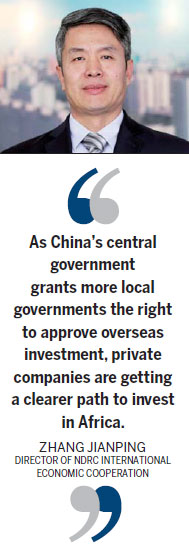
"Private companies are using their own pocket money, so they tend to be more cautious; and as China's central government grants more local governments the right to approve overseas investment, private companies are getting a clearer path to invest in Africa."
While energy and mineral resources are still major targets for Chinese investors - although manufacturing is slowly developing on the continent - there is a clear delineation in how companies from China are investing in Africa.
State-owned enterprises, for instance, are working on major energy, infrastructure and mining projects, giving private companies the room to engage in smaller projects. In many cases, private Chinese companies are branching out into agriculture, manufacturing and retailing.
Zhang clarifies that ZTE and Huawei are not the typical private companies he is talking about. "These two companies have become multinationals; here I'm referring to small and medium enterprises that tend to be labor-intensive. "
He raises an example in South Africa, where there are so many Chinese shops that they have created a new Chinatown.
"While state companies have strategic considerations, private companies are driven purely by profits," Zhang says. "So they engage more seamlessly into the local economy."
Thus far, African governments have been working with both state-owned and private investors indiscriminately, Zhang says.
"They are facing more or less the same problems when they do business in Africa, depending on the country's laws and regulations. For example, in the southern part of the continent where the British influence is strong, governments are highly aware of labor rights, so investors need to deal with unions and take care to understand minimum wages. The laws apply to all investors."
Chinese investors, specifically in mining, construction, and oil and gas exploration, are also seeing the benefits of developing locally. Zhang says Chinese companies used to ship coal and minerals back to China for domestic plants, but are now processing the raw materials locally and building industrial parks.
"The mineral development park in Zambia is a good example," he says. The park mainly processes copper.
In the construction industry, he says, Chinese companies are also expanding from building roads and traditional railways "to bidding for highways and airports".
Still, Zhang laments the fact that China is a latecomer to Africa's economic surge.
"This is obvious in the oil and gas industries," Zhang says. "Western countries started their exploration in the colonial periods. They now have control of most high-quality oil and gas fields. If we want to get involved, we either do our own prospecting or we buy exploration rights from Western companies at much higher prices."
The Luanshya copper mine in Zambia, for instance, was exploited for decades by a Dutch company when Nonferrous Metal Mining Co bought an 80 percent stake in 2009 for $50 million.
Indeed, more Chinese companies are looking to form partnerships with multinationals in oil and gas fields, Zhang says.
"In South America, many Chinese companies jointly hold stakes in mines with multinationals - this model can be applied to Africa."
Zhang says the belief among Chinese investors that the natural resources sector in Africa is a tough nut to crack for international investors is not true.
"Natural resources are the biggest treasures for African governments, so they have set a high bar for foreign investors. But if the economy is not good enough, they have to open the door for revenue."
African governments currently are not very picky about which sectors are receiving the most interest from Chinese investors. He adds that African countries tend to promote investment in industries that are most mature in their countries, such as copper in Zambia, cotton and textiles in Malawi and Zimbabwe, and hydropower in Guinea.
One bit of advice for Chinese investors that Zhang offers is to consider public-private partnerships to reduce risks and the high costs involved in infrastructure. Shenzhen Energy, for instance, used its own capital to build a power plant years ago in Ghana, from which the Ghanaian government buys electricity from Shenzhen Energy at a pre-negotiated rate.
"This model can incorporate capital from several parties and therefore accelerate the construction of infrastructure, but this model is based on long-term partnerships that require sound rules and regulations," Zhang says. "We need mature laws to regulate both the government and companies' behavior."
He warns Chinese investors not to bribe local officials. "In the long run, it will hurt Chinese investors' image and eventually hurt the business."
Apart from public-private projects, Chinese investors should also consider clustering around each other, Zhang says, pointing to the benefits of building industrial development parks.
"There are about 10 industrial parks being developed by Chinese investors across Africa, some of which, like the Eastern Industrial Park in Ethiopia, are finding success," he says. "By staying close to each other, companies can enjoy good water and power supplies, as well as build a complete industrial chain."
But this requires involvement from the Chinese government.
"It might take a long time for companies to negotiate with the governments, but talks between governments could certainly expedite this process," he says.
wangchao@chinadaily.com.cn
(China Daily Africa Weekly 12/19/2014 page9)
Copyright 1995 - . All rights reserved. The content (including but not limited to text, photo, multimedia information, etc) published in this site belongs to China Daily Information Co (CDIC). Without written authorization from CDIC, such content shall not be republished or used in any form. Note: Browsers with 1024*768 or higher resolution are suggested for this site.
License for publishing multimedia online 0108263 Registration Number: 130349