 |
|
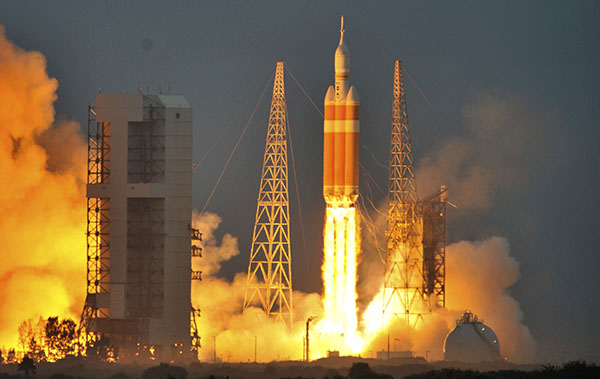
The Delta IV Heavy rocket with the Orion spacecraft lifts off from the Cape Canaveral Air Force Station in Cape Canaveral, Florida December 5, 2014. [Photo/Agencies] |
CAPE CANAVERAL - A US spaceship designed to one day fly astronauts to Mars blasted off on Friday for an unmanned trial run around Earth.
A Delta 4 Heavy rocket, currently the biggest booster in the U.S. fleet, lifted off at 7:05 a.m. EST (1205 GMT) from Cape Canaveral Air Force Station in Florida.
United Launch Alliance, a partnership of Lockheed Martin Corp and Boeing Co that builds and flies the rocket, delayed launch by one day to resolve a problem with sluggish values in the rocket's first-stage propellant system.
Riding atop a fountain of fire, the 24-story-tall rocket soared out over the Atlantic Ocean, punching through partly cloudy skies as it headed into orbit.
Cars jammed roads for miles around the spaceport as thousands of people attempted to catch a glimpse of the launch. The last time crowds this large gathered for rocket-watching was for the space shuttle, which stopped flying in 2011.
"I think it's a big day for the world, for people who know and like space," NASA Administrator Charles Bolden said during a NASA Television interview shortly before launch.
"Everything may not go right, but everything that does go right means that we've bought down one more risk on this vehicle," Bolden said.
NASA has been working on Orion, along with a new heavy-lift rocket, for more than eight years. The design of the rocket has changed, but Orion survived the cancellation of a lunar exploration program called Constellation to become the centerpiece of a new human space initiative intended to one day fly astronauts to Mars.
For its orbital debut, Orion, built by Lockheed Martin, is expected to fly as far as 3,600 miles (5,800 km) from Earth so that it can slam back into the atmosphere at a speed of about 20,000 mph (32,000 km/h).
During re-entry, temperatures on Orion's heat shield should soar to 4,000 degree Fahrenheit (2,200 degree Celsius), close to what spaceships returning from lunar orbit will experience.
Splashdown in the Pacific Ocean is expected around 11:30 a.m. EST (1630 GMT) on Friday.
NASA has spent more than $9 billion developing Orion, which will make a second test flight, also without crew, in about four years. A third mission, expected around 2021, will include two astronauts on a flight that will send the capsule high around the moon.
Since the end of the Apollo moon program in 1972, astronauts have flown only a few hundred miles above Earth.
Related:
Factbox - Key milestones of NASA's first test flight of Orion capsule

Copyright 1995 - . All rights reserved. The content (including but not limited to text, photo, multimedia information, etc) published in this site belongs to China Daily Information Co (CDIC). Without written authorization from CDIC, such content shall not be republished or used in any form. Note: Browsers with 1024*768 or higher resolution are suggested for this site.
License for publishing multimedia online 0108263 Registration Number: 130349