 |
|
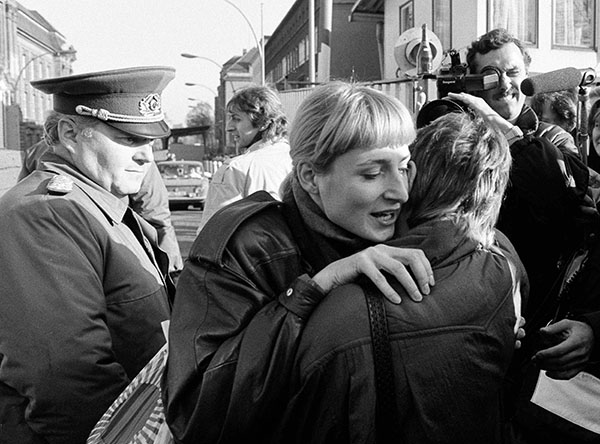
An East Berlin citizen (C) embraces a West Berlin woman while an East German border soldier watches at the border checkpoint Invalidenstrasse after the opening of the East German border was announced in Berlin, in this November 10, 1989 file photo. [Photo/Agencies] |
In the German city of Dresden, trumpet player Ludwig Guettler takes pride in the soaring spires of the Baroque Frauenkirche church, rebuilt from the ruins of World War II, and sees them as a symbol of his city's vibrant economic and cultural life.
About 440 km away in Dortmund, Ilse-Margarete Bonke tries to save her decaying city from a drug scourge by picking up heroin needles from the streets, but finds her work impeded by kids who sneak up on her, pulling off her curly wig and spitting in her face.
The two cities have met contrasting fates since the crumbling of the Berlin Wall 25 years ago - with Dresden becoming a magnet for high-tech firms and a cultural center, and Dortmund sinking into deep economic depression. What may be surprising about this picture is that Dresden is in the former east and Dortmund was once a symbol of the economic might of the capitalist west.
Overall, the west still remains more prosperous than the east: Unemployment is higher in the east, disposable incomes are lower and populations are older as the young move west for better opportunities. But the east has been catching up, and in some key cases there has been a reversal of fortunes. That is largely due to the still mandatory "solidarity fees" instituted after reunification to help raise the former East Germany's living standards - payments that are becoming increasingly controversial as swathes of western Germany fall into decline.
Big contrast
In Dresden, one of former East Germany's biggest cities with about 530,000 inhabitants, the economy is humming and universities are attracting students, who often stay on after graduation to work for Dresden's myriad research institutions and computer chip producers. Unemployment is at 8 percent, compared with an average of 9 percent for all of the former East Germany; the city has been out of debt since 2006.
"Dresden is a prime example of a structural transformation done well," said Deputy Mayor Dirk Hilbert.
Some 75,000 jobs, about a third of the city's workforce, were eliminated after the Berlin Wall collapsed in 1989. But the city managed to persuade new employers like Volkswagen and international chip manufacturers to open plants in Dresden. Since reunification, some $1.9 trillion to $2.5 trillion was funneled into the east to turn ailing collective farms and state-run factories into competitive capitalist businesses. The lion's share of the money came from western Germany's citizens, towns and states.

Copyright 1995 - . All rights reserved. The content (including but not limited to text, photo, multimedia information, etc) published in this site belongs to China Daily Information Co (CDIC). Without written authorization from CDIC, such content shall not be republished or used in any form. Note: Browsers with 1024*768 or higher resolution are suggested for this site.
License for publishing multimedia online 0108263 Registration Number: 130349