 |
|
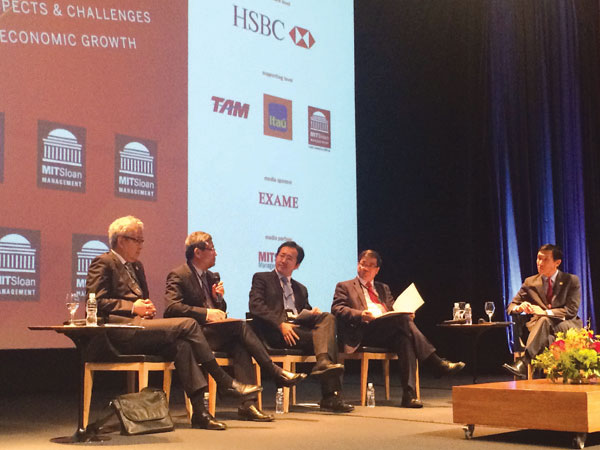
Economists from China, the US and Latin America calls for a better mutual understanding and trust between China and the Latin American region at the 2014 MIT Sloan Latin America-China Conference held in Sao Paulo on Aug 29. [Zhang Fan / China Daily] |
Chinese companies should adapt to Latin American culture as a first step in entering this market and develop long-term relationships with local partners, said Roberto Rigobon, a professor of applied economics from Massachusetts Institute of Technology, at the 2014 MIT Sloan Latin America-China Conference held in Sao Paulo on Aug 29.
According to a survey recently published by EXAME, a leading financial magazine in Brazil, 68 percent of Brazilian entrepreneurs view Asia as competitors and 31 percent think Asian countries are "threats" to Brazil.

The survey covers about 100 CEOs of leading Brazilian companies and 71 percent of them do business with China. The survey also shows that only 27 percent view China's role in the country as "very positive" while the figure for Japan was 53.
"Brazil's business circle is actually afraid of China's rapidly entering their market," said Rigobon. "They are concerned about China's entering the oil industry and mining industry, though there are already many foreign companies operating in these fields."
This year marks the 40th anniversary of China-Brazil relations. Going by just the trade figures, the increase is significant. Trade volume between the two nations in 2013 surpassed $90 billion and the increase rate of the first five months of 2014 reached 7.3 percent compared with the same period of last year.
Chinese President Xi Jinping's recent visit to Brazil also impressed the country with the 56 contracts signed involving fields such as energy, infrastructure and technology.
Meanwhile, China's direct investment into Brazil also increased sharply from only $83 million in 2009 to $395 million in 2010, making China Brazil's largest investment sourcing country.
"There are some people worrying about China's role in this area, but the fact is China's investment to Brazil and to the region is still limited compared with China's total foreign direct investment (FDI)," said Chen Taotao, a professor of economics at Tsinghua University.
Chen said China only holds less than 5 percent of the worldwide FDI and among the total FDI to Latin America, China only has a limited share of 1.5 percent.
"Why does China's investment, though it only has such a small piece of pie, become a big topic? The reason is that China's investment actually rose when the world's investment declined, which made China's investment very distinctive," Chen said.
She said the regional market has already been a very competitive place because of years of economic ties with the US and Europe, but Chinese companies are not strong enough to face the large local and global enterprises.
"So the fact is that Chinese companies' position in this market is weak, share is little and we are new," Chen added.
To ease such tension among business circles, Rigobon said Chinese companies need to understand more about local culture and provide more transparent information.
"Though we have developed relations for many years, there is still a lack of personal contact between Chinese and local companies," Rigobon said. "When a Chinese company comes to Latin America, it should understand the culture of the region and that once a partner is developed, it is a lifetime relationship."
"We need to see the money and people at the same time," he added.
Sun Pei, an associate professor of industrial economics at Shanghai-based Fudan University, said in the next phase of the China-Brazil relationship, Brazil and other countries in the region cannot simply export commodities, but should learn from China's cost-control manufacturing skills to help increase the competitiveness of their own products and an open market is rather important.
"China used to introduce foreign investment to help develop its industry and gained major progress in technology and skills. Brazil should also learn from it," Sun said.
Contact the writer at fanzhang@chinadailyusa.com.

Copyright 1995 - . All rights reserved. The content (including but not limited to text, photo, multimedia information, etc) published in this site belongs to China Daily Information Co (CDIC). Without written authorization from CDIC, such content shall not be republished or used in any form. Note: Browsers with 1024*768 or higher resolution are suggested for this site.
License for publishing multimedia online 0108263 Registration Number: 130349