ISTANBUL - Turkish President Tayyip Erdogan formally asked former foreign minister Ahmet Davutoglu on Thursday to form a new government and be his prime minister, CNN Turk news channel reported.
|
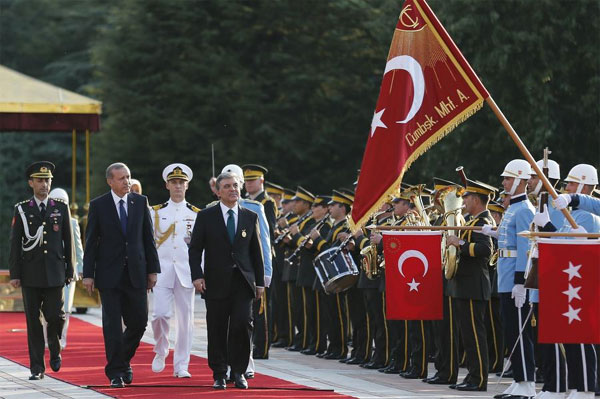 |
| Turkey's new President Tayyip Erdogan (2nd L) and outgoing President Abdullah Gul (R), attend a handover ceremony at the Presidential Palace of Cankaya in Ankara August 28, 2014. [Photo/Agencies] |
Tayyip Erdogan was sworn in as Turkey's president earlier, cementing his position as its most powerful leader of recent times, in a step opponents fear heralds more authoritarian rule and widening religious influence in public life.
Whether stirring crowds with fiery election speeches or, as on Thursday, swearing an oath as Turkey's first popularly elected president, Tayyip Erdogan casts himself as the heir of one man above all others - a man whose life ended on an army gallows.
On the forsaken island of Yassiada off the shores of Istanbul, a military tribunal sentenced to death Adnan Menderes, Turkey's most popular prime minister by share of vote, a year after a 1960 coup that would set the stage for military interventions lasting another two generations.
"We are realising Menderes dream," Erdogan, 60, said on the campaign trail ahead of his presidential election victory, in a frequent evocation of his hero. "They may have executed him but he is not forgotten. He is in our hearts."
To Erdogan's supporters his inauguration is the culmination of a half-century struggle by popular governments against unelected generals and other parts of the secular elite who saw themselves as the true keepers of Turkey's republican values.
It is a schism in Turkish society reaching back to the 1920s when Mustafa Kemal Ataturk forged a secular republic from the ruins of an Ottoman theocracy, banishing Islam from public life.
Erdogan, a devout Muslim whose political origins lie in a banned Islamist movement, has said he will exploit the full limits of the presidency, which has been a largely ceremonial post in recent decades. Eventually, he hopes a new constitution will endow his office with expansive executive powers.
He believes an active presidency will better express what he refers to as "the national will": empowering what he sees as a long downtrodden, often poor, religiously conservative populace and finally capping the power of an army that staged three outright coups and pressed a fourth government to quit in 1997.
"Erdogan sees himself as a political actor with a historic mission: to rebuild the republic using the country's majority as its foundation," said Etyen Mahcupyan, a columnist at the pro-government newspaper Aksam, who has advised Erdogan.
Critics warn Erdogan's aggressive style has cooled foreign allies and polarised Turks along sectarian lines. Concentrating more power in his hands could fracture the country, they say.
Erdogan - who remains Turkey's most popular politician - faced down massive anti-government protests last year organised by mainly young, secular-minded opponents over his perceived authoritarian and conservative tendencies.
'Dictatorial' leadership
Similar charges were levied against Menderes, whom the Western media described as "dictatorial" at the time of his ouster for jailing journalists, targeting non-Muslim minorities and brutally suppressing anti-government protests.
Menderes became prime minister in 1950 in Turkey's first truly free and fair election and won twice more, clinching victory thanks to massive support from the devout rural poor. Erdogan has also served three terms as prime minister.
A populist who eased some of the republic's strict curbs on Islam, Menderes raised alarm among military ranks that he might roll back Ataturk's reforms.
Menderes was deposed and hanged with two ministers. A fourth committed suicide in detention.
Yassiada, used by the Byzantines to exile royalty, still bears the sports hall that served as the courtroom. Barely visible is part of the lettering high on the wall that once read: "Justice is the Foundation of the State."
Erdogan's government renamed Yassiada, a former navy outpost located some 16 km (10 miles) offshore, Democracy and Freedom Island and has mooted plans to develop it into a tourism centre.
For now, its crumbling edifices serve as an unofficial monument to one of Turkish political history's great tragedies.

Copyright 1995 - . All rights reserved. The content (including but not limited to text, photo, multimedia information, etc) published in this site belongs to China Daily Information Co (CDIC). Without written authorization from CDIC, such content shall not be republished or used in any form. Note: Browsers with 1024*768 or higher resolution are suggested for this site.
License for publishing multimedia online 0108263 Registration Number: 130349