China Forum | Kong Chushan
NAS and other intelligence departments have for a long time been stealing commercial secrets for the benefit of US companies
On May 19, the United States Justice Department indicted five Chinese military officers on charges of hacking into computers and stealing valuable trade secrets from leading US companies. This is the first time that the US has leveled such criminal charges against a foreign country.
Washington's unfounded charges and crude behavior have once again demonstrated to the world its hypocrisy and shamelessness.
Edward Snowden's revelations about the US National Security Agency's surveillance programs let the whole world know that the US is the biggest cyber spy, perhaps that is why it is so desperate to point a finger at China.
The US argues all countries engage in espionage, but it does not provide information gathered by its intelligence agencies to US companies for commercial gain. In other words, it is saying that it is OK for the US to steal information from other countries if it is in the name of safeguarding its national security, even if it is the commercial secrets of other countries, but it isn't using that information to help US enterprises.
It is well-known the US wants to maintain its hegemony in the world, so it is not surprising that the US puts its own security interests above other countries' national sovereignty.
According to Snowden's revelations, US institutions have long been involved in large-scale and organized cyber theft as well as wiretapping and surveillance activities against foreign political leaders, companies and individuals, and the intelligence it has obtained naturally includes a large number of business secrets. People cannot help but ask: Do all those countries, enterprises, institutions and individuals around the world pose a threat to US national security?
If the US does not take advantage of these information, why does it take the trouble to steal them?
In 1977, the US launched a commercial espionage program, called "Echelon", to steal other countries' business intelligence on a large scale by monitoring phone conversations and intercepting cable and fax messages, and offered this information to American companies. Over the decades, the US intelligence department's stealing of commercial secrets has continuously increased rather than lessened.
An article published in The New York times in 1995 disclosed the details of the US' theft of economic information from Japan, and pointed out that as overseas commercial interests have become the US' foreign policy priority, spying on its allies' for economic gain has become a key task of the Central Intelligence Agency.
In fact, for many years such reports have been fairly common in the US' mainstream media, and there have been many reports of the US government, enterprises and intelligence agents making handsome profits through stealing commercial secrets.
In 1999, the European Parliament conducted a two-year investigation into the US' intelligence agencies theft of European countries' business secrets . It published a 200-page report on July 11, 2001, which concluded that the US had been stealing European countries' business intelligence on a large scale for a long time and this information was handed over to the US companies, helping them obtain enormous commercial advantages.
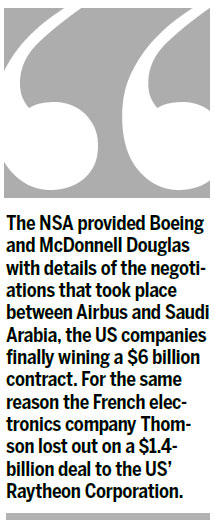
The report by the European Parliament gave a large number of examples. For example, the NSA provided Boeing and McDonnell Douglas with the negotiations that took place between Airbus and Saudi Arabia, the US companies finally wining a $6 billion contract. For the same reason the French electronics company Thomson lost out on a $1.4-billion deal to the US' Raytheon Corporation.
In addition to the European countries, the report also listed a number of cases concerning the US' commercial espionage activities in countries such as Japan.
After the Prism program was exposed, the European Parliament held another hearing about the US' espionage activities and recommended that countries pay more attention to the advice of the report.
Even after the Snowden disclosures, the US has not made clear why it has been monitoring Brazilian and Mexican oil companies.
Now the whole world knows that the US is the biggest aggressor in cyberspace.
The author is a Beijing-based expert on international relations.

Copyright 1995 - . All rights reserved. The content (including but not limited to text, photo, multimedia information, etc) published in this site belongs to China Daily Information Co (CDIC). Without written authorization from CDIC, such content shall not be republished or used in any form. Note: Browsers with 1024*768 or higher resolution are suggested for this site.
License for publishing multimedia online 0108263 Registration Number: 130349