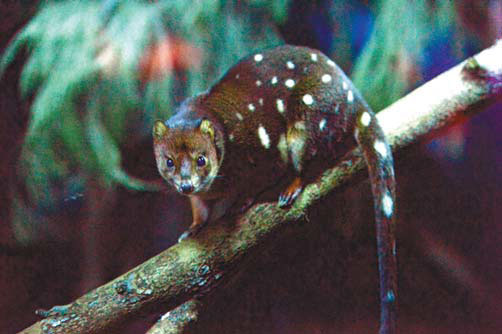
Small, furry marsupials such as the bandicoot, quoll and tree possum are in dramatic decline in northern Australia, and feral cats could be the cause, according to an analysis reported on Wednesday.
Chris Johnson, a wildlife conservation professor from the University of Tasmania, said small mammal species were at risk of extinction across the continent, but the changes in the north were marked.
"There's a pretty clear picture, and it shows that lots of species have declined dramatically," Johnson said.
|
A spotted quoll is seen at Taronga Zoo in Sydney on Wednesday. Small, furry marsupials such as the bandicoot, quoll and tree possum are in dramatic decline in Australia's north. Peter Parks / Agence France-Presse |
"Where we can infer the timing of decline, it's been fairly recent. And there are now large areas where small mammals are either very rare or don't exist, but the habitat looks like it should support small mammals."
Johnson said that while scientists discussed the changes as a "new wave of decline", it was not clear how sudden it was except that it became very noticeable in the early 1990s, particularly in places such as Kakadu National Park, a conservation area in the Northern Territory.
About 20 small native mammals have disappeared from Kakadu in recent decades, including ratlike bandicoots, northern quolls, tree possums, and the weasellike phascogale, he said, adding that similar declines had occurred elsewhere.
A new analysis from a database of current mammal populations reported to a meeting of experts in Canberra on Wednesday has allowed researchers to compare the current wave of extinction across different species with those in the past, Johnson said, adding that it revealed some common factors.
"First, the extinctions are occurring mainly in ground-dwelling animals of small body size which live in open, dry habitat. This points the finger of suspicion strongly at an introduced predator - the cat," he said.
"We have seen similar extinction patterns driven by predators like foxes in southern Australia, so the big question was, Is history repeating itself, or is it something new?"
He said the declines were in species eaten by cats, an animal believed to have been introduced with European settlement in the late 1700s.
"Where there are no cats, there have been no declines," he said.
He said because cats had been around for so long and the declines were more recent, the question was what had changed to make them such a damaging predator.
Johnson said the use of fire by cattle farmers seemed to have played a role, given there had been no significant land clearing or evidence of disease in northern Australia.
"It is probably no one thing, but the data point to a combination of several effects - all of which tend to favor the hunting style adopted by cats, which places small ground-dwelling animals at greater risk," he said.

Copyright 1995 - . All rights reserved. The content (including but not limited to text, photo, multimedia information, etc) published in this site belongs to China Daily Information Co (CDIC). Without written authorization from CDIC, such content shall not be republished or used in any form. Note: Browsers with 1024*768 or higher resolution are suggested for this site.
License for publishing multimedia online 0108263 Registration Number: 130349