 |
|
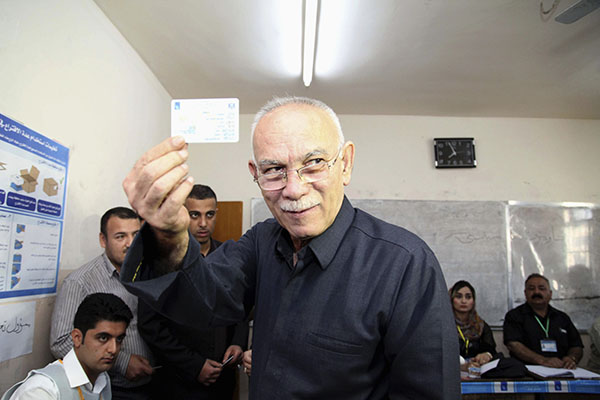
Noshirwan Mustafa, leader of Kurdish opposition movement "Gorran" (Change), holds up his ID card during regional parliamentary elections at a polling station in the northern Iraqi of province Sulaimaniya, April 30, 2014. Iraqis headed to the polls on Wednesday in their first national election since U.S. forces withdrew from Iraq in 2011, with Prime Minister Nuri al-Maliki seeking a third term amid rising violence. [Photo/Agencies] |
BAGHDAD - Eleven years after the United States led a war to topple Saddam Hussein's regime in Iraq, the country is facing political, social and economic crises, which are destabilizing the country and threatening to disintegrate it.
Many Iraqis voice their hope that the parliamentary elections on Wednesday would bring about a change to the country, but local observers caution that Iraq still needs a long way to go before it becomes a stable and prosperous state.
|
 Iraqis begin to vote in parliamentary elections |
HOPE FOR CHANGE AMONG ALL
Differences and divisions among Iraq's main communities - mainly the Shiites, Sunnis and Kurds -- have been deepening, reflecting the failure of the political process to curb the power struggle among the country's factions that erupted after the US-led invasion.
But all the groups would like to see a change in the country.
"All the blocs are focusing on change, which means political leaders have realized that there is a desire among the Iraqi public for a change, and therefore the strategies of electoral campaigns are concentrating on showing that they are willing to make a change," said Ahmed al-Sharifi, a researcher with the Iraqi Center of Strategic Study.
Many Sunni and Kurdish politicians and even some Shiite political blocs have accused Iraqi Prime Minister Nuri al-Maliki's Shiite-led government of pursuing a policy of hegemony and marginalizing its government partners, calling for a change of the government.
However, the mainly Shiite State of Law Coalition, led by al- Maliki, is campaigning under the goal of forming a governing majority, saying internal conflicts in the current power-sharing "partnership" government are the cause of Iraq's political, economic and security crises.
"Together we can reform the political process... We have to make a change on the basis of the constitution to meet the expectation of our people," al-Maliki told a recent election rally for his coalition in Baghdad.
But some critics say the definition of the so-called majority government is ambiguous. If a majority government means one run mainly by Shiites, it would be a dangerous and unrealistic choice for Iraq, a country composed of many diverse ethnic groups.
Al-Maliki's opponents say that the ambiguous idea of majority government is a political approach that would cause more internal division among Iraqis because it would not stop the sectarian and political polarization and would increase animosity among the factions.

Copyright 1995 - . All rights reserved. The content (including but not limited to text, photo, multimedia information, etc) published in this site belongs to China Daily Information Co (CDIC). Without written authorization from CDIC, such content shall not be republished or used in any form. Note: Browsers with 1024*768 or higher resolution are suggested for this site.
License for publishing multimedia online 0108263 Registration Number: 130349