HOUSTON - US astronomers have discovered what may be the most massive black hole ever known in a small galaxy about 250 million light-years from Earth, US media reported Thursday.
 |
|
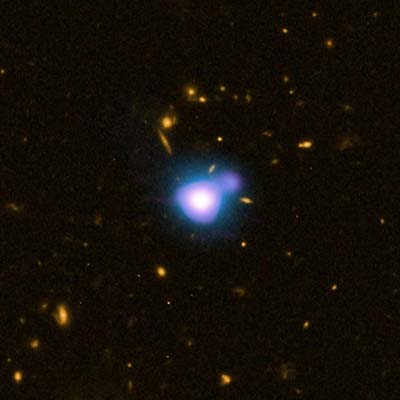
Undated composite image courtesy of NASA shows the most distant X-ray jet from a quasar named GB 1428+4217 located 12.4 billion light years from Earth. X-ray data from NASA's Chandra X-ray Observatory is shown in blue, radio data from the NSF's Very Large Array are shown in purple and optical data from NASA's Hubble Space Telescope are shown in yellow. Giant black holes at the centers of galaxies can pull in matter at a rapid rate producing the quasar phenomenon. The researchers believe the length of the jet in GB 1428 is at least 230,000 light years, or about twice the diameter of the entire Milky Way galaxy.?[Photo/Agencies] |
"This is a really oddball galaxy," said study team member Karl Gebhardt of the University of Texas at Austin. "It's almost all black hole. This could be the first object in a new class of galaxy-black hole systems."
The mass is so far above normal that the scientists took a year to double-check and submit their research paper for publication, according to the study's lead author, Remco van den Bosch.
Scientists now are intrigued not so much by the black hole's size, but where it lies, according to the report.
The black hole rests in the center of a disk-shaped galaxy smaller than our own Milky Way, surprising scientists who didn't figure to find something that big in a modestly sized galaxy.
The newly discovered black hole has a mass equivalent to 17 billion suns and is located inside the galaxy NGC 1277 in the constellation Perseus. It makes up about 14 percent of its host galaxy's mass, compared with the 0.1 percent a normal black hole would represent, scientists said.
"We don't understand how to make such a massive black hole in such a puny galaxy," said Karl Gebhardt, one of the University of Texas astronomers who made the discovery.
Scientists have several theories that help explain the relationship between the size of a black hole and its host galaxy.
"We do not understand yet which of these theories is best," said Remco van den Bosch.
A black hole is a region of spacetime where gravity prevents anything, including light, from escaping. Understanding the nature of black holes and their host galaxies is important because astronomers would like to better know how galaxies form and evolve.

Copyright 1995 - . All rights reserved. The content (including but not limited to text, photo, multimedia information, etc) published in this site belongs to China Daily Information Co (CDIC). Without written authorization from CDIC, such content shall not be republished or used in any form. Note: Browsers with 1024*768 or higher resolution are suggested for this site.
License for publishing multimedia online 0108263 Registration Number: 130349