COLUMBUS, Ohio - It's 6:10 pm on a Thursday in October, just days before the US elections. Before the clock hits 6:29 pm, 11 political ads will have aired on the local NBC channel in Columbus, Ohio.
One tells voters that Democratic President Barack Obama has not proposed a legitimate economic plan for the country. Another suggests that policies of Republican candidate Mitt Romney would undermine the future for America's children.
Yet another says Romney would effectively deny many women crucial cancer screenings by proposing cuts to Planned Parenthood. The very next ad calls Obama an extremist on abortion who supports leaving babies "out to die."
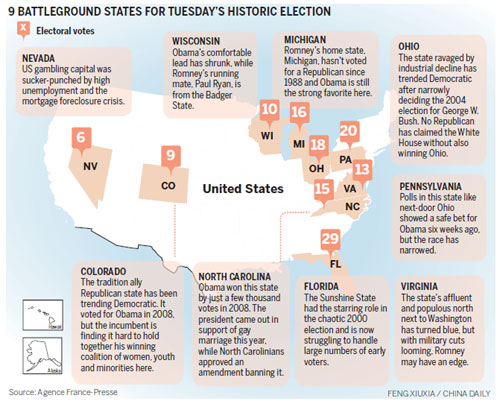
Ohio is being inundated with such dueling ads in the final days before the November 6 presidential election, as Obama and Romney both look to the state's 18 electoral votes as a crucial step toward the 270 electoral votes needed to win the White House.
The presidential race is now a fight in eight or so politically divided "swing" states, but nowhere more so than Ohio. Amid the chaos of the campaign's closing days, the state has become an arena for credibility-stretching banter, and a testing center for the growing science of political advertising.
The most expensive campaign in US history (nearly $2 billion) and the free-spending independent groups that have poured more than $200 million into political ads - many of them directed at Ohio - have given analysts a high-profile chance to examine some simmering questions about such ads.
Among them: How many ads is too many, before viewers tune them out? And what do campaign ads lead voters to do, exactly?
Election-year political ads are a meticulously studied subject, and increasingly are used to target specific groups and encourage specific outcomes.
Some research, for example, suggests that pro-Democrat ads are particularly effective at swaying voters' opinions, while pro-Republican ads typically are more effective at getting party supporters to show up at the polls.
For all the analysis that has been done on campaign ads, academic and commercial research has yielded few answers on the precise impact that ads have in determining who wins an election.
That is especially true, analysts said, in the type of advertising free-for-all that Ohio residents are seeing on their televisions now - wave after wave of ads with overlapping and similarly dark, daunting messages.
Campaign ads became tiresome long ago for many Ohio residents, but some viewers figure that the ads must be working, or the campaigns wouldn't keep running them.
"I think poorly of those ads and don't think they work, but there are so many of them I think it must be not so," said JoAnne Harvey, a Columbus small business owner who, as an undecided female voter is much coveted by both campaigns.
In a reflection of how so many ads can essentially nullify one another, Harvey and another dozen Ohioans interviewed generally could not recall the details of a single campaign ad that stood above the others. Those who could acknowledged that they weren't sure which side the ad was meant to benefit.
Targeting viewers
Political advertising has become a multibillion-dollar market that some television station sales managers predict soon could be a year-round category of advertising.
It has become increasingly sophisticated in "micro-targeting," the art of going after specific groups of viewers.
For example, Democrats have been found to be more frequent television watchers than Republicans, and Democrats candidates in 2008 ran more than twice as many ads as Republicans during science-fiction shows, reality dating programs and telenovelas, according to research by Washington State University professor Travis Ridout and others.
Those programs as well as talk shows and court shows tended to skew Democratic in viewership while crime and sports programs skewed Republican, Ridout's study found.
But does the science of political advertising work?
One study completed last month found Obama's ads moving voters away from Romney, while Romney's ads were much more likely to encourage Republicans to vote, rather than shift preferences among voters.
The findings were based on a survey of more than 2,300 registered voters who said they were independents or not deeply committed to one party. They were shown one or several of the campaigns' ads by the research software company Qualtrics and the research firm Evolving Strategies.
"Romney doesn't seem to have a lot of ability to have people moving in and out of the independent pool, but he has a lot of room to change the equation in determining who turns out to vote," said Adam Schaeffer of Evolving Strategies.

Copyright 1995 - . All rights reserved. The content (including but not limited to text, photo, multimedia information, etc) published in this site belongs to China Daily Information Co (CDIC). Without written authorization from CDIC, such content shall not be republished or used in any form. Note: Browsers with 1024*768 or higher resolution are suggested for this site.
License for publishing multimedia online 0108263 Registration Number: 130349