China on Wednesday said it opposes any Middle East country's push to acquire nuclear weapons, and joined Russia in opposing the use of force on the Iran nuclear issue, as Iranian President Mahmoud Ahmadinejad visited China for a regional summit involving 11 heads of state.
Analysts said the stance by China and Russia has played a vital role in preventing an external "armed intervention" that would escalate turmoil in the Middle East, while criticizing the double standard held by some Western countries on nuclear weapons.
 |
|
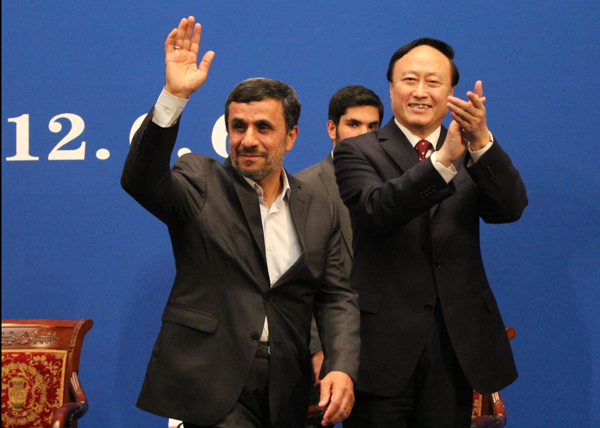
Iranian President Mahmoud Ahmadinejad waves to students after giving a speech at Peking University in Beijing on Wednesday. Zhang Yunbi / China Daily |
Premier Wen Jiabao, meeting Ahmadinejad on Wednesday in Beijing, said China has been pushing for diplomatic efforts in settling the Iran nuclear issue in an impartial way.
Wen said China cherishes "traditional friendship" with Iran, and supports Iran's efforts on economic and social development.
"China is willing to work together with Iran to maintain and develop concrete bilateral cooperation," Wen said, adding that China-Iran trade is built on mutual benefit and matches the demands of the domestic economic development of both countries.
The Iranian president thanked China for respecting Iran's sovereignty and legitimate rights, saying that Iran is willing to continue solving problems with some countries through dialogue and negotiation.
Ahmadinejad also said Iran is willing to further enhance mutual cooperation with China in trade, energy, investment and tourism.
The Iran nuclear issue has remained unsettled in recent years, with the United States and some European countries accusing Iran of pursuing nuclear weapons and pressing the country with rounds of economic sanctions.
Iran says the nuclear programs are for civil use.
Voices of possible military attacks on Iran by the US or Israel have frequently made the headlines.
China and Russia reiterated their opposition to the use of, or threats to use, force on the Iran nuclear issue, adding that they do not agree on exerting excessive pressure and imposing unilateral sanctions against Iran.
A joint statement of the two countries released on Wednesday stressed that efforts should be made to prevent the situation from escalating into a confrontation.
It warned that if such an escalation occurs, countries in the region as well as the entire international community will be grimly affected.
"The joint statement and Wen's statement reflected two levels of China's nuclear policy," said Zheng Yu, a professor on Russian studies of the Chinese Academy of Social Sciences.
"China is against the spread of nuclear weapons, which is consistent with the worldwide norm. It also opposes the West having a double standard, where they see some countries practically holding nuclear weapons without a word of accusation, while hardening sanctions on those who are just developing nuclear technology."
Hua Liming, a former ambassador to Iran and now a researcher with the China Institute of International Studies, called China and Russia "the major strength" preventing an armed intervention against Iran in the current delicate regional situation in the Middle East.
"Beijing and Moscow are playing important roles, keeping up pressure on Western countries to give more space to negotiation, while calling on Iran to be more flexible and transparent," Hua said.
Tension on the Iran nuclear issue recently eased as talks between Iran and the International Atomic Energy Agency have resumed. Another round of talks between Iran and the IAEA, aiming to clarify possible military dimensions to Iran's nuclear program, has been scheduled for Friday in Vienna.
China on Tuesday said it welcomes Iran's engagement with the IAEA on clarifying possible military dimensions to the country's nuclear program.
Ahmadinejad arrived in Beijing to visit China and attend the Shanghai Cooperation Organization summit on Tuesday. He is also expected to visit China's Xinjiang Uygur autonomous region.
Iran is an observer state of the SCO.
Contact the writers at wujiao@chinadaily.com.cn and wangchenyan@chinadaily.com.cn
Copyright 1995 - . All rights reserved. The content (including but not limited to text, photo, multimedia information, etc) published in this site belongs to China Daily Information Co (CDIC). Without written authorization from CDIC, such content shall not be republished or used in any form. Note: Browsers with 1024*768 or higher resolution are suggested for this site.
License for publishing multimedia online 0108263 Registration Number: 130349