Briton's eye keeps his design on track
Updated: 2011-10-09 08:29
By Tiffany Tan (China Daily)
|
|||||||||||


|
 |
|
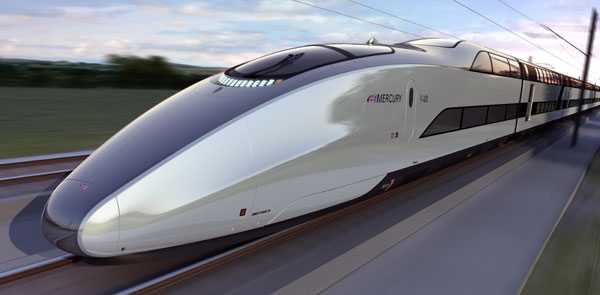
Paul Priestman believes that the new high-speed train is vital for the future of Britain and says his concept, Mercury (above), could follow in the design footsteps of the Concorde, the Spitfire, Rolls Royce and the Routemaster bus. Provided to China Daily |
Not many outside the design and transport industries know that Paul Priestman's firm is responsible for the look of what currently is one of China's fastest trains. And the Englishman prefers it stays that way.
"The train has become such an icon of China" that it wouldn't be appropriate to trumpet it as a British design, says Priestman, 50, in an exclusive interview during the first Beijing Design Week, which ended on Monday.
His London-based firm, Priestmangoode - founded in 1989 with former college classmate Nigel Goode - has designed a bewildering array of products for clients worldwide: hotel rooms, cosmetics packaging, restaurants and cafes, radiators, airport terminals, lighting fixtures, a water-saving device.
But in recent years the company has been concentrating on, gigantic projects for transport clients such as Qatar Airways, Kingfisher Airlines, Airbus, Embraer and Virgin trains. And then there's CSR Qingdao Sifang Locomotive, one of the world's largest rolling stock manufacturers and among the producers of China's newest trains.
"We're also now working on cruise ships - which I think is possibly a new area in China," says Priestman, the firm's president.
Because of this growth potential, as well as Priestmangoode's ongoing work with Sifang Locomotive (which started in 2009), the British firm will soon open an office in Qingdao, a major seaport and industrial base in Eastern China. It is Priestmangoode's first overseas office, and only its second base in 22 years in the business.
Priestman, who was part of British Premier David Cameron's 2010 trade delegation to China, says that penetrating the Chinese market is a longterm project, a process of relationship building and cultural understanding.
"Forming relationships on a personal level before you become business associates is essential," he wrote in a blog for Design Week magazine last year. One of the biggest things the British firm learned while working here is how its Chinese client comes up with its train designs.
"In the West, normally when you're set a project, they say, we start here and we finish here. And the first stage is to design maybe three different concepts. They select one concept and then that one concept is developed. A to B," Priestman says.
"In China, we develop 10 concepts, and then choose three. It's probably a better approach. If there's a problem in the Western approach, then you have to go right back to the beginning. But in China it seems that you can blend these designs together at a later date."
Understanding Chinese culture, he says, includes designing train carriages that incorporate hot water dispensers - a must for Chinese passengers who love their fresh, hot tea.
Priestmangoode, as part of its eight-year contract with Sifang, is now busy designing more Chinese intercity and subway trains. A February 2010 report in Britain's Daily Express put the Sifang contract at 10 million pounds (99 million yuan). Priestmangoode declined to confirm the amount.
At the same time, it is advising the Chinese firm's in-house design team how to create products for the world market.
One of Priestman's innovations: "moving platforms" for a totally inter-connected rail infrastructure, the company says, "where local trams connect to a network of non-stop high speed trains enabling passengers to travel from their local stop to a local address at their destination (even in another country) without getting off a train".
"I'm under no illusion this is a big idea," says Priestman. "But we have to think big. The world is going to be a very different place in 10 to 20 years time and we have to think of alternative ways of travel."
In this competitive world, don't British designers fear that the Chinese they are now mentoring might someday put them out of business?
"No, I think we've been in this position forever," says Priestman, a member of the UK's Creative Industries trade mission to the Beijing Design Week. "We've always managed to stay ahead because of our thinking. It comes from a rich culture - as in China - but we have a very multicultural culture and I think we're very good at picking styles from other countries and bringing them together in our own way.
"The other thing about UK design, and my company, is that we are designing for other nations. So you look at our work and you cannot say that that is British style, because we're very careful of making sure that that is not British style. And there aren't many countries that do that," he says. "It is quite developed. It's one step ahead."
You can contact the writer at sundayed@chinadaily.com.cn.






Hot Topics
Libya conflict, Gaddafi, Oil spill, Palace Museum scandal, Inflation, Japan's new PM, Trapped miners, Mooncake tax, Weekly photos, Hurricane Irene
Editor's Picks

|
|

|
|

|
|